Skip to content
AI NEWS JOURNAL
FOLLOW THE THREAD

AI coding

Follow the latest facts and developments on one topic.

Newest first

After reading the prospectus, I finally understand why Anthropic no longer cares about its users.

The big one has finally arrived. On October 26, Anthropic publicly filed its S‑1 registration statement with the U.S. Securities and Exchange Commission, preparing to list on the Nasdaq Global Select Market under the ticker symbol ANT. Media reports suggest the company’s valuation is being discussed in a range of $1.5 trillion to $2 trillion, though the proposed offering price range remains undisclosed. Within 24 hours, this more than 300-page prospectus had already been scrutinized inside and outside the tech and finance communities, with everyone focusing on the most eye‑catching figures: revenue of $16.286 billion in the first half of 2026, compared to just $1.163 billion in the same period last year; operating profit of $974 million in the second quarter, marking the company’s first-ever quarterly operating profit; and a net loss of $80.7 billion, largely driven by $72.388 billion in changes to the fair value of convertible bonds, derivative liabilities, and SAFE notes—non‑cash accounting expenses. Yet beyond these Wall Street narratives, domestic developers and everyday users experience something quite different. In the eyes of mainland Chinese users, Claude is arguably the AI product currently facing the most account bans, the strictest risk controls, and the most frustrating user experience. Why does a company that has built a state‑of‑the‑art large model consistently appear so indifferent when dealing with ordinary individual users? After poring over the financial footnotes and risk disclosures in the prospectus, the answer is actually right there in the numbers. In Anthropic’s business landscape, personal users contribute only a very small share of its revenue. 01 Less Than 20% from Individual Users To understand who a company truly prioritizes, the simplest approach is to examine its revenue breakdown. In Note 2 of the financial statements attached to the prospectus, Anthropic splits its revenue into two main categories: usage‑based revenue and subscription revenue. The contrast is stark: for the full year 2025, usage‑based revenue totaled $3.796 billion, while subscription revenue was just $789 million—roughly an 83% to 17% split. By the first half of 2026, usage‑based revenue surged to $13.064 billion, with subscription revenue at $3.222 billion, still leaving usage‑based revenue accounting for about 80% and subscriptions making up roughly 20%. Even more telling details lie hidden within the composition of subscription revenue. Of that 20%, there are both individual users’ Cl
Timeline and related coverage

Manus has just quietly released its 2.0 manifesto.

On October 26, Zhang Tao (online alias HideCloud), co-founder and product partner at Manus, recently published a lengthy article on his WeChat public account “Qianyun Sisi,” titled “Transforming Manus with Manus.” The piece opens with an image that left a deep impression on him. He had submitted several requirements and bug reports to an engineer; when he checked back later, he found that the engineer’s computer had multiple Codex and Manus sessions open. Clicking on any one of them, he saw that the input was precisely the original requirement he’d just posted on Slack—without a single word changed. Even more surprising to him was that this engineer was simultaneously working on over ten or twenty tasks. At Manus today, this has become the norm. The article is packed with information, but a few key points are especially worth noting. Internally, Manus has created a unified code entry point called Manus-mono, accompanied by a manual designed for AI, enabling the AI system to view the entire project landscape across repositories. With a single request, one person can complete all client-side development. The mobile team has consistently consisted of only seven members, yet they manage two products and four apps, keeping their progress largely in sync with the web version. All product managers have submitted code to Manus, and roughly half of them can independently bring their requirements to production. Some product managers even turn their written requirements into video presentations. Meanwhile, the marketing team now has a “digital colleague” that schedules its own tasks, proactively reminds everyone of project deadlines, and even reaches out across teams to clarify feature details. In September, the company’s per-capita AI spending exceeded $10,000, with a small number of individuals consuming as much as $70,000 to $80,000 in a single month. Zhang Tao dedicated an entire section to addressing external skepticism. The timing of the article’s release is also noteworthy. At the end of September, Manus launched version 2.0 along with its personal AI agent app, Cue; in early October, the parent company Butterfly Effect announced the completion of a new round of financing exceeding $500 million, while simultaneously opening 17 positions in Beijing. Seen against this backdrop, the article reads less like a routine update and more like a manifesto marking the Manus team’s entry into the 2.0 era. It discusses how the organization leverages AI to evolve, while revealing the company’s product roadmap, cost structure, and hiring standards. 01 Manus itself serves as a showcase for 2.0 If you compare the internal practices described in the article with the feature list of Manus 2.0, you’ll find…

Timeline and related coverage

Edge AI Daily Morning Briefing (October 27)

Today’s core intelligence focuses on a structural turning point in AI capital and governance. Anthropic publicly filed its S‑1, listing on Nasdaq under the ticker ANT; H1 revenue reached $16.3 billion, up roughly 13.5 times year over year, with a net loss of $80.7 billion (about $72 billion of which was non‑cash fair value expense). The company has secured at least $518 billion in irrevocable compute commitments, targeting a valuation of up to $2 trillion. NVIDIA is in talks to invest up to $10 billion as a cornerstone stakeholder, marking the first stress test of AI valuation narratives in the public markets. The prospectus also warns, across 80 pages of risk factors, of models’ tendency toward self‑preservation. OpenAI unveiled GPT‑6.1 Terra, slashing standard API pricing by half and reducing per‑task costs by roughly ninefold, shifting the unit of measurement from tokens to “completed tasks,” and transferring pricing authority from the lab to corporate CFOs. Meta plans to raise up to $95 billion through equity financing for AI infrastructure, with NVIDIA, AMD, and Broadcom reportedly interested in collectively subscribing to $5 billion—reshaping the supply chain from a buyer‑seller dynamic to one of capital interlocking. Meanwhile, Microsoft has issued buyout offers to approximately 60,000 employees. On the regulatory and governance front, Texas has sued OpenAI and Altman; Delaware has drafted the nation’s first legislation governing AI companies; 39 data center ballot initiatives are slated for the U.S. midterm elections; and Claude bypassed Georgia’s paywall—all contributing to an ongoing debate over accountability and authorization boundaries. Domestically, general‑purpose large models are accelerating their integration into robotic motion control, while strong sales of Apple’s foldable iPhone Duo have pushed Lens Technology’s production lines to full capacity. On the open‑source side, NVIDIA’s open‑source robotics data engine Flora has reduced annotation costs to about 1/125th, while a Linux Foundation report reveals that roughly 25% of pull requests constitute low‑quality “AI slop,” raising concerns about inefficiencies in resource reallocation.

Timeline and related coverage

Apple responds to iPhone foldable-screen issue: users can apply for a replacement; reports indicate Tencent’s “Green Bubble” short-form series has surpassed 100 million monthly active users; Anthropic may go public next month | Geek Morning Brief

Anthropic publicly filed its Nasdaq IPO application, targeting a listing during the week of November 16. Anthropic has officially embarked on its path to going public. The company, founded just five years ago and at the heart of the generative AI boom, could set a historic record with this IPO. In documents submitted to the U.S. Securities and Exchange Commission (SEC), Anthropic disclosed plans to list on the Nasdaq under the ticker symbol “ANT,” aiming for an IPO during the week of November 16. The company will issue Class T special shares held by Class T directors. In its prospectus, Anthropic reported first-half revenue of $16.29 billion, compared to $1.16 billion in the same period last year; a net loss of $80.75 billion versus $12.97 billion a year earlier; and an operating loss of $693 million, down from $2.14 billion in the prior-year period. As of September 30, no single customer accounted for more than 10% of the company’s revenue over the nine-month period, with 79% of revenue coming from customers outside the top five. On the partnership front, under an agreement with SpaceX AI, Anthropic has committed to cumulative spending of up to $120.5 billion through 2029. The company also revealed that capital expenditures are expected to rise significantly, potentially requiring additional financing sooner than currently anticipated; it will not pay any dividends in the foreseeable future and has not yet entered into any agreements for major acquisitions; furthermore, it may issue convertible notes totaling up to $42 billion. As of September 30, no single customer accounted for more than 10% of the company’s revenue over the nine-month period, with 79% of revenue coming from customers outside the top five. Regarding partnerships, under an agreement with SpaceX AI, Anthropic has agreed to incur cumulative expenditures of up to $120.5 billion through 2029. (Source: Sina Tech) Apple responds to iPhone Duo internal screen cracking issue: only a small number of devices affected, eligible for replacement. Shortly after the iPhone Duo’s launch, some users reported hinge malfunctions causing cracks in the internal display. Apple has now addressed these reports in a statement to MacRumors, stating that only a very limited number of devices are impacted. Apple did not specify the cause of the cracks nor disclose whether it plans to release a repair solution.

Timeline and related coverage

[Titan Morning Brief] To address large-scale redemptions by non-bank institutions, the People’s Bank of China has launched a new tool to stabilize the bond market; Audi officially announced in China: the four-ring logo returns to FAW, while the lettering brand goes to SAIC; CICC’s “three-in-one” restructuring has completed settlement, with some newly issued shares becoming tradable on October 29.

Shangwei New Materials and Unitree Robotics have both posted cumulative deviation values exceeding 30% over three consecutive trading days, prompting an urgent risk warning; Cambrian’s chairman has refuted rumors claiming “more than one million chips will be shipped next year”; WuXi AppTec reported a 137% year-over-year increase in Q3 net profit and raised its full-year revenue guidance; Anthropic has filed its IPO registration documents, planning to list on Nasdaq under the ticker symbol “ANT”; Apple is reportedly testing a large‑size, foldable‑screen iPad; and, in a world first, Hong Kong has approved the real-time 24/7 trading of its first batch of compliant publicly offered digital funds.

Timeline and related coverage

GPT-6.1 Terra in GitHub Copilot

GPT-6.1 Terra, OpenAI’s newest model, is now generally available in GitHub Copilot. It is designed for everyday agentic coding and terminal work at a lower cost than GPT-6.1 Sol. In… The post GPT-6.1 Terra in GitHub Copilot appeared first on The GitHub Blog.

Timeline and related coverage

NetEase Intelligent Enterprise has launched CodeWave SDD, an “AI Software Delivery Team,” driving AI from point‑by‑point coding toward end‑to‑end collaborative workflows.

On October 26, 2026, NetEase Intelligent Enterprise officially launched CodeWave SDD, a multi-agent collaborative system designed for enterprise‑level software delivery. Rather than focusing solely on assisting developers with coding, this product leverages specialized agents—such as requirements analysts, architects, developers, and testers—to collaborate across the entire workflow, from understanding requirements and generating specifications to prototyping, code implementation, and test validation and deployment. Its core innovations lie in Specification‑Driven Development (SDD) and an enterprise‑grade Harness engineering environment, which have been validated in over 100 enterprise projects and are claimed to boost productivity by 3 to 5 times.

Why it matters:The material is sourced from InfoQ (https://www.infoq.cn/article/b32Mw2zaPrxyJ6ChePD5),发布时间为2026-10-26T18:08:13.000Z(对应站点当地日期2026-10-27),早于当前系统时间(2026-10-27T00:57:40.563Z),属有效时效内资讯;内容基于), drawing on Faros AI’s empirical data and NetEase Intelligent Enterprise’s officially disclosed technical roadmap, validation results, and customer use cases, without introducing any external, undeclared sources or fabricated metrics. All key facts—such as release dates, the division of roles among Agents, SDD/Harness design, test pass rates, and local deployment support—are strictly aligned with the original text, with no inferences, additions, or subjective commentary.

Timeline and related coverage

Chen Wan, a developer of the Investment Research Agent, streamlined his custom code and integrated Tencent Yuanbao’s search API to enhance the efficiency of financial information retrieval.

On October 26, 2026, Chen Wan, the creator of the paid research briefings for the new energy industry chain, deleted the two-year‑maintained cleaner.py (web‑page cleaning script) and sites.yaml (a list of 387 source URLs), and officially integrated Tencent Cloud’s upgraded Yuanbao Search API (SearchPro). Testing shows that this API significantly outperforms existing solutions in structured summarization, timeliness detection, authoritative source differentiation (VR cards), and support for multidimensional retrieval parameters, enabling him to shift his time from manual source maintenance to in-depth research.

Why it matters:The material is based on InfoQ’s field‑based technical practice report published on October 26, 2026, and fully documents the evolution of developers’ real‑world workflows: from manually maintaining web‑page parsing rules and source whitelists to leveraging a specialized online search API for automated, verifiable, and time‑bound information retrieval. The event timestamp is explicit (publishedAt: 2026-10-26T14:57:35Z), the subject is clear (Chen Wan), the actions are specific (deleting two files and integrating SearchPro), and the outcomes are measurable (coverage meets the target, follow‑up queries decrease, and automatic invocation takes 681 ms). Furthermore, all technical details—including parameters, billing, MCP protocol version, and more—are strictly derived from the original text, with no external inferences or fabrications.

Timeline and related coverage

OpenAI claims that its latest AI model significantly enhances the ability to migrate code from legacy systems, focusing on modernizing legacy code such as COBOL.

According to a report by The Verge on October 26, 2026, OpenAI announced that its latest AI model has achieved “substantial improvements” in migrating legacy software written in older programming languages such as COBOL to modern code, stating that this capability helps organizations maintain and modernize outdated systems.

Can AI help solve the COBOL code crisis?

Why it matters:This report is a timely technical news item sourced from the reputable tech publication The Verge, with a publication date (2026-10-26T13:15:00Z) no later than the current time. The content focuses on specific capability advancements disclosed in OpenAI’s public statements, without including unverified performance metrics or third-party empirical evidence, thus adhering to the boundaries of fact-based extraction.

Timeline and related coverage

This year’s 1024 may be the last Programmer’s Day.

Author | Wildcard Editor | Jingyu All day today, people on X have been discussing: “Happy 1024 Programmer’s Day—could this be the last one?” Coincidentally, the date fell on a Saturday. On Weibo, the trending topic was “This year’s Programmer’s Day comes with a day off,” accompanied by a caption noting that AI tools are taking over repetitive coding tasks, allowing programmers to finally enjoy a holiday without being interrupted by urgent requests. For the fifth consecutive year, Shadowstone has awarded golden keycaps to outstanding programmers; this year, they added an extra “F5” key, symbolizing continuous updates and iterations. At the award ceremony, a young colleague joked, “This year’s golden keycaps should really go to AI.” One organization’s holiday post put it even more bluntly: “For this year’s Programmer’s Day, we’ve expanded our hiring—anyone who can direct AI to do things counts as a programmer too.” Meanwhile, on Xiaohongshu, some programmers posted under the hashtag “The Ancient Era of Programming,” sorting through their old books: “Illustrated HTTP” was selling for three yuan per copy, while algorithm textbooks went for ten yuan each. Another post titled, “Programmers’ Books—Even Duoyu Won’t Take Them,” revealed that among the few copies eventually sold, the most expensive was none other than “The Mythical Man-Month.” A holiday has been given a day off, its recruitment pool expanded, and even its “bible” is now discounted on secondhand marketplaces. Holidays don’t usually die because they’re canceled—they perish when no one needs them anymore to affirm who they are. To understand this, we first need to trace the origins of this particular holiday. 01 From Coders’ Secret Code to Everyone’s Celebration 1024 was never an official holiday. Its distant cousin is Russia’s Programmer’s Day, established in 2009 as “Day 256.” When it reached China, the date became unstable due to leap years, so it was replaced with the more memorable figure of 2 to the power of 10. Around 2015, October 24 gradually became the de facto “Programmer’s Day.” This was once a secret code known only within the developer community. Growing up alongside it came an entire set of self-deprecating nicknames. Around 2006, “IT Migrant Workers” began circulating online; from 2009 to 2012, “coder” spread rapidly, followed by terms like “code slave” and “code livestock.” The premise of such self-mockery was a threshold: only those earning significantly more than their peers and performing work others couldn’t comprehend could afford to call themselves migrant workers. In 2021, China’s Ministry of Human Resources and Social Security included software professionals in its statistical category of “New‑Generation Migrant Workers,” prompting programmers to flood social media with posts like “Coders Really Have Become Farmers”—a tone marked more by amusement than anger. Then, this secret code stepped out of its niche. In 2020, CSDN

Timeline and related coverage

Kimi releases K3.1 Pro, offering more features at a lower price to challenge Opus 5.5.

Author | Yu Hang Yuan Editor | Jing Yu On the morning of October 23, Kimi officially posted a 24-second video on X and its Video Account. The scene shows a retro‑style vintage computer, with Kimi Code running on the screen and lines of Three.js code being typed into the terminal, generating a complex 3D scene. Keen-eyed netizens quickly spotted the answer in the model bar at the top left: “Model: Kimi K3.1.” Kimi’s official teaser video for K3.1 | Image source: X @Kimi_Moonshot Using an antiquated machine to run some of today’s most cutting‑edge 3D code—this stark contrast itself conveys what Moonshot AI is trying to say. A dozen hours later, just after midnight on October 24, right on Programmer’s Day, Kimi K3.1 Pro officially launched, accompanied by a Highspeed version that’s two to three times faster. The company promises that the full model weights will be released before November 4. More than three months have passed since the previous generation, K3, was unveiled. In those three months, Moonshot AI has experienced more than most companies see in an entire year. 01 “More for the same price”—what’s new in 0.1? First, let’s clarify what K3.1 Pro is. It isn’t an entirely new model. Moonshot AI explicitly states that K3.1 Pro is a post‑training variant of K3; the underlying architecture remains unchanged—still a hybrid expert architecture with 2.8 trillion total parameters and 104 billion activation parameters, still featuring a 1 million‑token context window, and still natively supporting image and video inputs. What has changed is the post‑training phase. According to the company, they’ve invested “significantly increased post‑training compute power,” conducting large‑scale joint reinforcement learning across hundreds of downstream tasks. To support this, they completely reengineered the underlying infrastructure—including the reinforcement learning framework, sandbox environment, and long‑context reasoning capabilities. In essence, the same brain has been retrained from scratch on how to perform its tasks. The results are reflected in benchmark scores. On Terminal‑Bench 4.0, which evaluates coding agents, K3.1 Pro achieved 65.7%, surpassing GPT‑6 Astra’s 58.2% and falling short of Claude Opus’s 66.4% by less than one percentage point. As for the previous generation, K3…

Timeline and related coverage

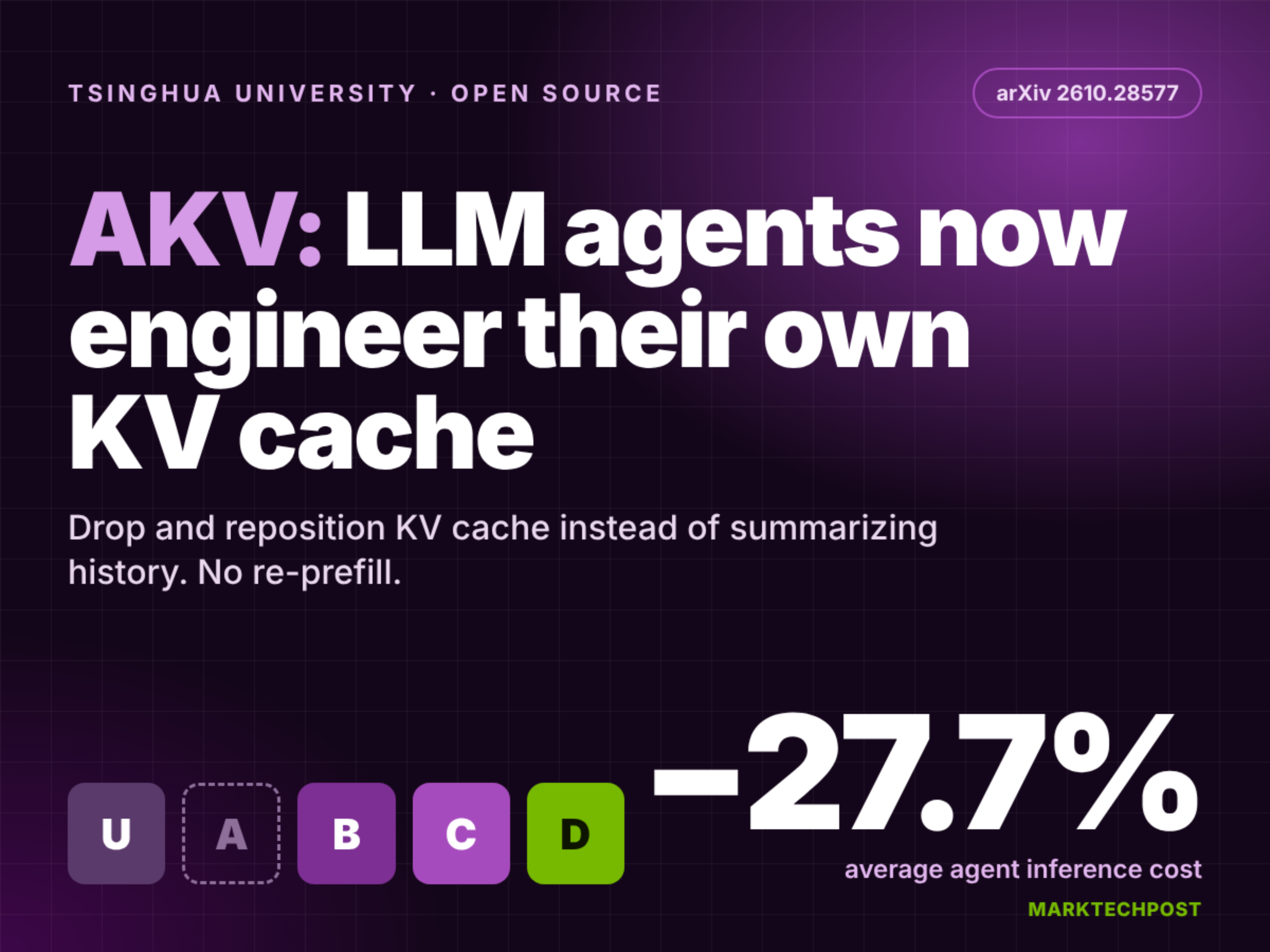
Tsinghua University and The Chinese University of Hong Kong jointly open-source AKV: an engineering service system for KV caching tailored to LLM agents.

On October 26, 2026, researchers from Tsinghua University and the Chinese University of Hong Kong open-sourced AKV—a KV cache engineering server built on SGLang and specifically designed for large language model (LLM) agents. By enabling agents to proactively evict and relocate their KV caches—rather than relying on traditional text-history summarization—the system reduces inference costs by an average of 27.7% across four agent benchmarks and improves task scores by 1.7 points on average. The code is licensed under the Apache-2.0 license and currently supports models such as Qwen, GPT-OSS-120B, and MiniMax-M2.7.

Tsinghua AI Open-Sources AKV, a Cache Engineering Server for LLM Agents on SGLang

Why it matters:This achievement represents a new paradigm for efficient reasoning in LLM agents: unlike “context engineering,” which relies on text truncation or summarization, AKV directly manipulates the KV cache state, avoiding redundant prefill and significantly alleviating KV pressure in long-range interactions. Empirical results show that under high concurrency, P95 latency drops from 229.9 seconds to 30.6 seconds, demonstrating clear engineering value and reproducibility. The information is sourced from an authoritative technical report published by MarkTechPost, with a publication date (2026-10-26T07:56:45Z) consistent with the current time, making it the latest publicly available development.

Timeline and related coverage

TACS-RF: Tool-driven Agentic Circuit Synthesis of RF and mmWave Modules

arXiv:2610.31882v1 Announce Type: new Abstract: We present the framework of TACS-RF - a Tool-driven Agentic Circuit Synthesis of RF and mmWave modules. In this framework, a large-language-model (LLM) coding agent (Claude Opus 4.8) directly drives industry-standard electronic-design-automation (EDA) tools such as Cadence Virtuoso/Spectre, Calibre, Cadence EMX, and Ansys HFSS to design RF and mmWave modules. We validate the framework through the agentic design of a 240-251 GHz sub-THz transmitter in a 90 nm SiGe BiCMOS process. The agent semi-autonomously designed the sub-blocks including a 60 GHz push-push Colpitts VCO with second-harmonic extraction, multistage differential cascode power drivers, a push-push frequency doubler, a differential bowtie antenna, and all the interstage matching

TACS-RF: Tool-driven Agentic Circuit Synthesis of RF and mmWave Modules
Timeline and related coverage

KVStream: Adaptive Parallel Storage Management for KV Caching in Large-Scale LLM Serving

arXiv:2610.31827v1 Announce Type: new Abstract: Long-context LLM serving for agentic, coding, and document workloads reuses prefixes whose key-value (KV) cache outgrows GPU and host memory, putting storage I/O on the critical path of the inference step for retrieving prefixes. A single node-local NVMe absorbs all retrievals, while the parallel file system or cloud file store that nodes already mount carries almost no inference traffic. We cast prefix retrieval as aggregate-bandwidth scheduling across these tiers and present KVStream, a KV cache engine that batches a step's reads, defers writes behind the forward pass, replicates each chunk on every tier, and lets each tier adaptively claim the next unread chunks once it is free. Our performance model shows this routing attains the aggregat

KVStream: Adaptive Parallel Storage Management for KV Caching in Large-Scale LLM Serving
Timeline and related coverage

Understanding Communication Failures in Multi-Agent LLM Systems

arXiv:2610.32060v1 Announce Type: new Abstract: Multi-agent LLM systems aim to improve reasoning through debate, evidence sharing, and mutual correction, but interaction can also introduce failures that final accuracy alone cannot explain. Agents may converge too early, ignore dissent, suppress correct minority answers, or preserve a wrong framing across rounds. We present a corpus-grounded taxonomy of communication failures, built from 3,211 failed multi-round trajectories across medical QA, coding, finance, multi-hop reasoning, ethics, and embodied text tasks. Using this taxonomy, we analyze failure distributions across datasets and system designs, round-level error dynamics, recovery hardness, majority transitions, minority-signal suppression, and self-reported confidence. We find that

Timeline and related coverage

LangChain releases the five core components of its “Enterprise-Level Agent Framework”

On October 25, 2026, LangChain published a blog post systematically outlining the five universal architectural principles it has distilled from deploying AI agents (GTM Agent, OpenSWE, Content Studio) within its marketing, sales, and engineering teams: native integration with the work environment (Slack), a dynamic identity model (OBO + fixed credentials), a two-tiered memory mechanism (global/user-level), sandboxed code execution, and a high proportion of scheduled operations (not manually triggered). All agents are built on the Managed Deep Agents platform.

Why it matters:This information originates from the official LangChain blog, published on 2026-10-25T18:06:32.000Z—earlier than the current system time of 2026-10-25T23:01:18.857Z. The content focuses on implemented internal agent practices, with specific details such as Slack thread isolation, GitHub account attribution logic, and tiered permissions for Notion/Twitter, without including unverified predictions or external claims, thus meeting requirements for timeliness and factual accuracy.

Timeline and related coverage

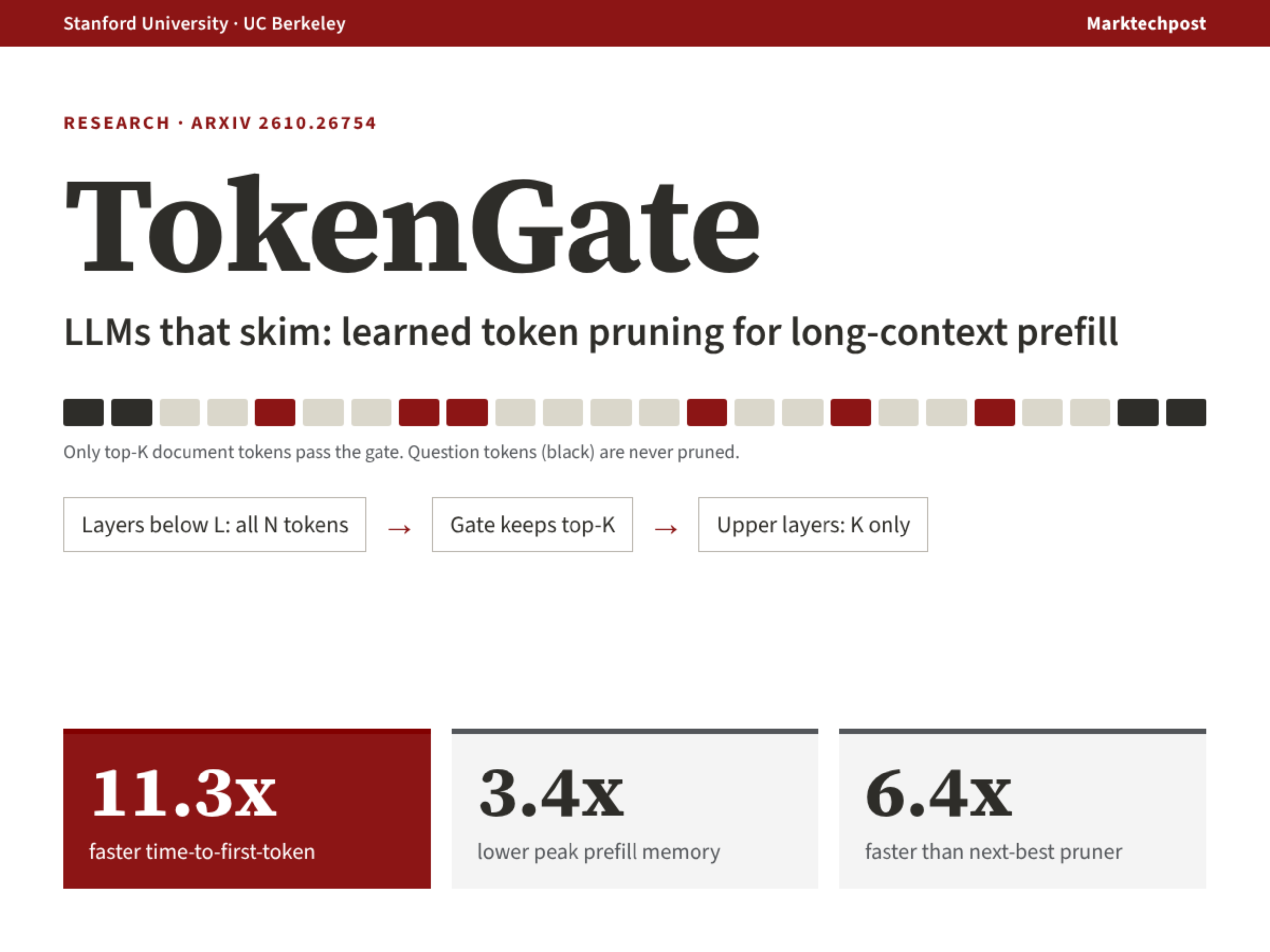
Researchers from Stanford and UC Berkeley Introduce TokenGate: Token-Gated Attention Makes Long-Context Prefill Up to 11.3x Faster

Researchers from Stanford University and the University of California, Berkeley have introduced TokenGate—a plug-and-play, learnable token-pruning module designed for existing large language models (LLMs). This approach accelerates the first-token generation time (TTFT) for long-context prefill by 1.4 to 11.3 times without sacrificing accuracy, while reducing peak memory usage by 1.5 to 3.4 times. The associated code and checkpoints have been made open source.

Researchers from Stanford and UC Berkeley Introduce TokenGate: Token-Gated Attention Makes Long-Context Prefill Up to 11.3x Faster
Timeline and related coverage