
Skip to content
AI NEWS JOURNAL
FOLLOW THE THREAD

AI coding

Follow the latest facts and developments on one topic.

Newest first

Researchers from Stanford and UC Berkeley Introduce TokenGate: Token-Gated Attention Makes Long-Context Prefill Up to 11.3x Faster

Researchers from Stanford University and the University of California, Berkeley have introduced TokenGate—a plug-and-play, learnable token-pruning module designed for existing large language models (LLMs). This approach accelerates the first-token generation time (TTFT) for long-context prefill by 1.4 to 11.3 times without sacrificing accuracy, while reducing peak memory usage by 1.5 to 3.4 times. The associated code and checkpoints have been made open source.
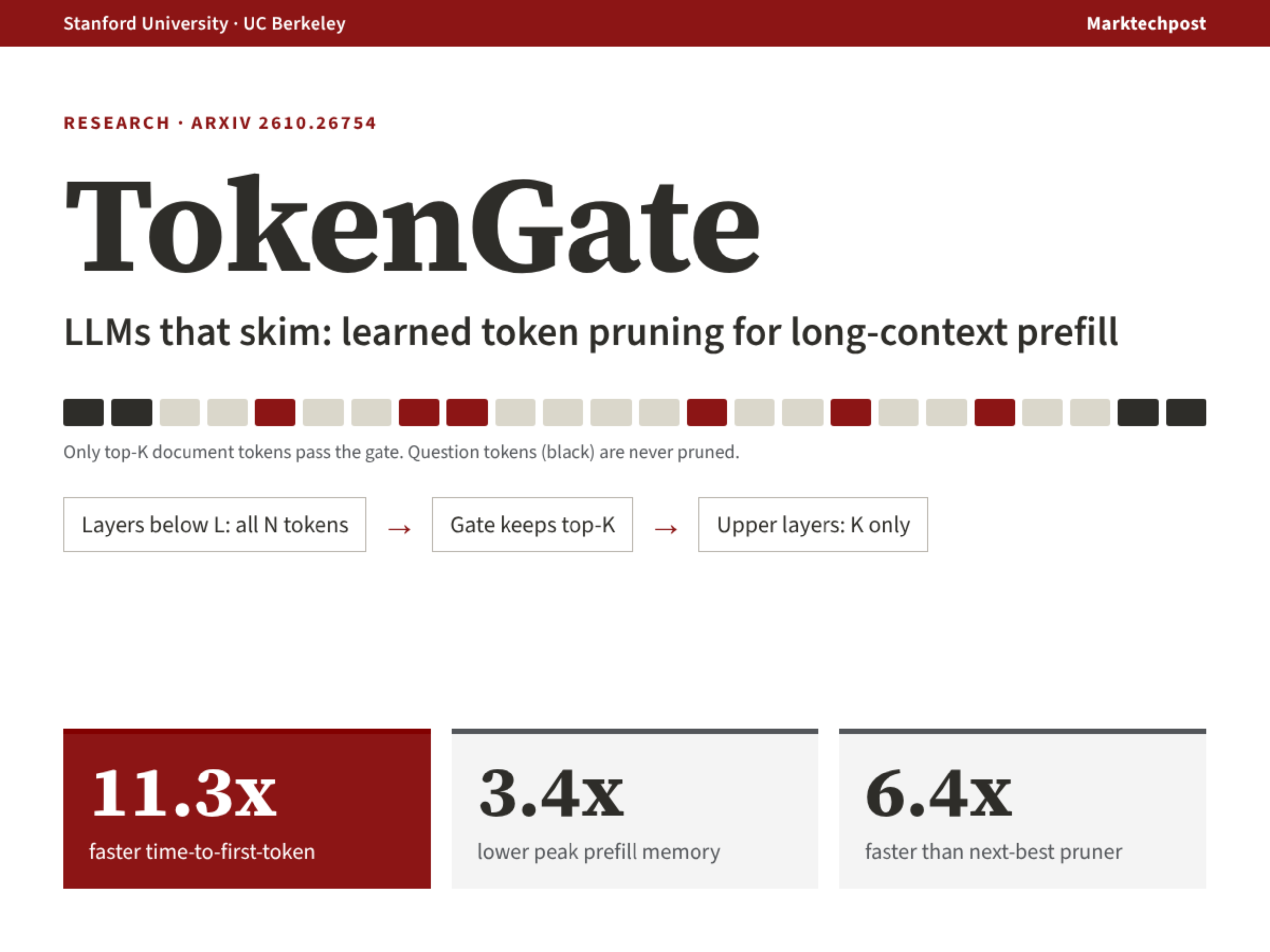

Researchers from Stanford and UC Berkeley Introduce TokenGate: Token-Gated Attention Makes Long-Context Prefill Up to 11.3x Faster
Timeline and related coverage

Kimi releases K3.1 Pro: Terminal task capabilities top the charts, with simulation debugging and multimodal programming showcasing the nascent form of embodied intelligence.

On October 25, 2026, Kimi released the K3.1 Pro model, which ranked first in the Terminal-Bench 4.0 terminal task benchmark with a 67.2% success rate. Its capabilities—including autonomously fixing emulator errors, performing physics simulations, conducting audio analysis, constructing 3D scenes, and editing videos—point toward exploring pathways in embodied intelligence technology.

根据报道中的虚拟人行走训练和模拟器调试制作的编辑示意,非软件实拍截图

Why it matters:The material is based on a hands-on test report published with authorization from Titanium Media, covering authoritative third-party benchmark data (such as Artificial Analysis and Terminal-Bench 4.0), official self-test results, and the author’s multi-scenario functional validation. It highlights the K3.1 Pro’s substantial advancements in execution performance, simulation closed-loop capabilities, and multimodal programming, while clearly noting performance limitations and undisclosed information (e.g., Flash/Ultra has not yet been released), in compliance with fact-checking and source attribution requirements.

Timeline and related coverage

A quarter of PRs are “AI garbage”! The Linux Foundation has released a new report: AI writes code 52% faster, yet open-source maintainers are even more exhausted.

On October 20, the Linux Foundation released a report indicating that generative AI reduces the time required for code writing by an average of 52%; however, open-source project maintainers estimate that roughly 25% of pull requests are low-quality “AI slop,” with this figure rising to 31% in large-scale projects. The report highlights that the efficiency gains have not been matched by corresponding reductions in review and governance costs, as only 35% of projects have established formal AI contribution policies, underscoring growing developer burnout and a trust deficit.

Timeline and related coverage

Release of a new benchmark for Nepali–English mixed-language speech recognition and a two-stage adaptation framework from synthesis to real-world conditions

On October 24, 2026, researchers published a paper on arXiv (ID 2610.30860v1), introducing the first Nepali–English code-switching ASR benchmark for spontaneous podcast scenarios, comprising 13,044 real-world utterances (15.45 hours), and proposing a two-stage adaptation approach that combines synthetic and real data: first, fine-tuning with synthetic speech generated by a 0.95-hour multi-speaker TTS model as supervision; then, incorporating group relative policy optimization (GRPO) with script-based rewards.

Synthetic-to-Real Code-Switched ASR: A Spontaneous Nepali-English Podcast Benchmark

Why it matters:This work directly addresses the core challenges of script obfuscation and high error rates at switching points in code-switching ASR for low-resource languages, by rigorously auditing data to prevent machine translation leaks and acoustic loops, and by making all validation texts, timestamps, episode metadata, and reconstruction scripts publicly available. The experimental results are statistically significant (p ≤ 0.001) and demonstrate generalization stability on monolingual benchmarks.

Timeline and related coverage

Research reveals the “norm–oracle gap” problem in benchmarking coding agents.

A paper published on arXiv on October 24, 2026, points out that current mainstream benchmarks for coding AIs—such as SWE-Milestone—suffer from a “specification–oracle gap”: the natural-language descriptions of tasks fail to capture crucial implementation details required for testing (e.g., constant names, module paths, and precise error messages), resulting in evaluations that measure the ability to reproduce upstream code rather than genuine understanding and reasoning.

What the Specification Did Not Say: Specification-Oracle Gaps in Test-Graded Coding-Agent Benchmarks

Why it matters:This study is the first to formally define this type of bias, develop a static analysis tool covering five languages (with 89.2% precision and 92.9% recall), and empirically demonstrate in SWE-Milestone that 25 milestone tasks contain non-inferable implicit dependencies, significantly increasing the failure rate (80.6% vs. 48.4%). These findings reveal that current leaderboards may systematically favor “name‑copying” agents. The results have been made publicly available, including the open-source auditing tool and corrective resources, offering both methodological and practical value.

Timeline and related coverage

IQuest-Q1: Advancing Foundation Capabilities for Agentic CLI Systems

arXiv:2610.30949v1 Announce Type: new Abstract: We present IQuest-Q1, a sparse Mixture-of-Experts (MoE) agentic foundation model with 320B total parameters (15B activated). IQuest-Q1 is developed through a three-stage process: (1) stable and efficient pre-training, combining Stable SplitNorm, Muon, and muP with a two-stage curriculum whose second stage increases the coding-data mixture, preserving a wide stability margin between safe and optimal learning rates; (2) fine-grained mid-training, expanding the data mixture across domains and formats and progressively extending the context; and (3) multi-scaffold with multi-version post-training, combining SFT, domain-specialized RL, and MOPD across various scaffolds to integrate complementary training signals and strengthen agentic coding capab

IQuest-Q1: Advancing Foundation Capabilities for Agentic CLI Systems
Timeline and related coverage

Major upgrade to Amazon Polly’s generative engine: 14 new voices added, and for the first time, support for Hindi and Finnish generative speech, with zero-code migration.

Amazon Polly’s generative engine has undergone a major upgrade, significantly enhancing speech naturalness, accuracy, and emotional expressiveness, while supporting low-latency streaming synthesis. Fourteen new generative voices have been added, covering nine regions, and for the first time, generative voices in Hindi (Arjun, Kiara) and Finnish (Suvi) are universally available. The entire update is a seamless, drop-in replacement, requiring no changes to API calls or code.

Timeline and related coverage

Flint-interactive: An interactive data visualization programming language for AI agents

Microsoft Research has unveiled Flint-interactive, a domain-specific language for building highly expressive, semantically rich interactive data visualizations. Its compiler automatically maps user interactions—such as clicks and brush selections—to semantic events and uses high-level operators to drive coordinated updates across multiple elements, including charts, tables, and text, significantly reducing the cost and development complexity of creating reliable interactive visualizations with AI agents.

Timeline and related coverage

OlmoEarth v1.3 Released: A High-Performance Open-Source Satellite Embedding Model for the Global Surface

The Allen Institute for AI has released OlmoEarth v1.3, offering planet-wide satellite embedding vectors at 10-meter resolution in both 64-dimensional and 128-dimensional formats, along with the interactive exploration tool Embeddings Explorer. It supports zero-code change detection, similar-region retrieval, and lightweight classification modeling.

Timeline and related coverage

Deep Insight: How AWS’s Open-Source Multi-Agent System Addresses Five Major Production-Grade Challenges

AWS Solutions Architecture Team has launched Deep Insight, an open-source multi-agent system designed for automated CSV data analysis and natural-language report generation. It systematically addresses five common challenges in production environments—agent orchestration, role-based model selection, stable operation, secure code execution, and observability—and has been validated in real-world scenarios such as LG Electronics and the re:Invent 2025 TechRecon.

Timeline and related coverage

Recursive releases Flint: a lightweight, AI-driven programming model that can run locally.

AI startup Recursive has unveiled Flint, an open-source coding model that it claims was developed primarily using its in-house AI research system, Eureka Machine. With just 40 billion parameters and only 2.5 billion activations in practice, the model can run offline on a standard laptop—such as an M4 Pro MacBook—at an inference speed of 131 tokens per second, outperforming most models of comparable size on benchmarks like SWE-Bench.

Timeline and related coverage

OpenAI's latest GPT-6 series models will be available on Google Cloud and the Antigravity platform.

OpenAI’s cutting-edge GPT-6 and 6.1 series models (Astra, Sol, Luna) will be launched on Google Cloud Model Garden in the coming weeks and integrated into Google’s agent-driven programming tool, Antigravity; this move makes Google the first mainstream cloud provider to offer all three major closed-source large models—Gemini, Claude, and GPT.

Timeline and related coverage

Claude Mods: The first implementation of an attention interface, a human-programmable agent interaction layer

Claude Mods is Anthropic’s programmable plugin system for Claude Code, representing an early form of the “Attention Interface”—it shifts the traditional machine-oriented agent harness toward a customizable interaction layer centered on human attention. Users can write Mods in TypeScript/JS or have Claude generate them automatically using natural language, thereby determining when to be interrupted, what content to see, and what decisions to make.

Timeline and related coverage

Claude Mods: A programmable attention interface that reshapes the collaboration paradigm between humans and AI agents

Claude Mods is a programmable plugin system for developers launched by Anthropic, marking a shift of the ‘agent harness’ from a machine-side interface to a human-side interface—namely, the ‘Attention Interface’. It enables users to customize Claude Code’s behavior, rendering, and interaction logic via TypeScript/JavaScript, thereby facilitating co-design workflows between humans and AI. This mechanism has already been applied to built-in features (such as You Should Know) and supports users in building plugins themselves or having them generated with Claude’s assistance.

Timeline and related coverage

NVIDIA releases Kumo Relational: the first foundation model for structured data that outperforms supervised learning without any training.

NVIDIA has launched Kumo Relational, a pre-trained relational foundation model that can perform predictive tasks—such as churn prediction, fraud detection, and demand forecasting—directly on enterprise‑grade relational databases, without the need for task fine-tuning, feature engineering, or table flattening. In 41 benchmark tests spanning 15 databases, it outperformed supervised models like XGBoost across the board, and on the SAP SALT enterprise benchmark, its MRR metric surpassed AutoGluon by 8%. The model supports databases with up to 500 billion rows and enables zero‑code predictive queries via Predictive Query Language (PQL).

Timeline and related coverage

SF Compute builds a programmable data center: leveraging physical delivery to power the GPU computing power trading market.

SF Compute was founded by Evan Conrad and is dedicated to building a neutral, programmable GPU computing‑power trading infrastructure that supports physical delivery. Its model rejects the abstraction of FLOPS as a commodity, emphasizing hardware heterogeneity, actual delivery, and real‑time constraints—such as interrupt tolerance, InfiniBand topology, and firmware versions. The platform has already facilitated tens of billions of dollars in transaction volume and introduced low‑level capabilities like dynamic InfiniBand subnet partitioning.

Timeline and related coverage

SF Compute builds a programmable data center: leveraging physical delivery to drive the marketization of GPU computing power trading.

SF Compute was founded by Evan Conrad and focuses on enabling programmable, physically settled trading of GPU computing power. It does not operate its own data centers; instead, it leverages full-stack technology to collaborate with third-party facilities in co-building a “sovereign compute cloud,” emphasizing market neutrality and infrastructure controllability. The company has already facilitated hundreds of millions of dollars in transaction volume and implemented key capabilities such as dynamic InfiniBand partitioning.

Timeline and related coverage

How Three Java Champions Leverage GitHub Copilot to Boost Development Efficiency: Focusing on Human-AI Collaboration and Shared Responsibility

Vlad Mihalcea, Patrick Baumgartner, and Frank Delporte, three seasoned Java Champions, shared their experiences using GitHub Copilot in production environments and open-source projects, emphasizing human-led problem definition, context anchoring, iterative validation, and ultimate accountability—rather than relying on AI to automatically generate code.

Timeline and related coverage

My obituary for programming

My obituary for programming Jeremy Scheff poignantly captures the key loss caused by coding agents for career programmers who enjoyed the puzzle of developing code: Programming turned into one of the greatest jobs you could imagine. You got paid to work on tricky little logic puzzles. The trickier the puzzle, the more you got paid. But even pretty simple puzzles were worth a lot of money because regular people just couldn't do it! No, they needed us. They would give us a problem and we would solve it the way we wanted. We set the strategy, we made the timeline, we defined what was and was not possible. If you're a programmer who thrives on building working systems and doesn't care too deeply about the problems solved along the way, LLMs are the gift that keeps on giving. If directly solvin

Timeline and related coverage