
Skip to content
AI NEWS JOURNAL
FOLLOW THE THREAD

Image Generation

Follow the latest facts and developments on one topic.

Newest first

Augmentation with Reinforcement Transformation for Low-textured Scientific Sketch Image Retrieval

arXiv:2611.05408v1 Announce Type: new Abstract: Low-textured sketch images are widely used in scientific applications, including wildlife conservation, archaeological illustration, and forensic composites. Learning from and retrieving such images is challenging because they lack detailed surface textures and visual variations commonly exploited by modern deep learning models. This paper proposes Augmentation with Reinforcement Transformation (ART) to fine-tune pretrained models to learn effective representations for accurate sketch image retrieval. Our key observation is that sketches are particularly sensitive to image transformations, such as rotation, flipping, zooming, and stretching. While some transformations preserve their structural integrity, others may introduce distortions that hinder representation learning. Instead of randomly choosing transformations to construct fine-tuning views, ART formulates augmentation selection as a multi-armed bandit (MAB) problem, where transformations are treated as arms and their effectiveness is continuously evaluated through rewards. This enables ART to adaptively construct reward-guided view banks before self-supervised fine-tuning; the subsequent representation loss does not feed back to ART. On Florida manatee sketches provided by Mote Marine Laboratory, ART achieves 71.40% average Top-1 accuracy for transformed-scar retrieval, compared with 68.83% for random augmentation selection, and 55.84% for location-aware sketch retrieval, compared with 18.18% for frozen CLIP.

CHROMA-MILL: Joint Low-Light Enhancement and White Balance under Colored Illumination

arXiv:2611.04092v1 Announce Type: new Abstract: Capturing an image in a low-light environment produces a weak, noisy sensor signal. Low-light image enhancement (LLIE) aims to restore it. Auto white balance (AWB) is also required for every image, and the same noisy signal degrades its ability to infer the scene illuminant. LLIE is typically performed first, followed by AWB, but this strategy remains largely unexamined because existing low-light datasets span a narrow range of illuminants and lack illuminant ground truth for evaluating AWB. We address this with CHROMA-MILL, a RAW dataset of 50 scenes captured with a DSLR and smartphone under four calibrated illuminants at eleven intensity levels. Because light is additive, we blend these captures in the linear RAW domain to synthesize physically valid illuminant mixtures with exact chromaticity ground truth. Benchmarking on this data, we find joint correction is best, and introduce CTI-Retinexformer, which supervises an illumination map, a chromaticity prediction, and an illumination-invariant scene embedding, outperforming the best cascade by 0.7 dB PSNR$_L$ and 1.1 $\Delta E_{00}$.

Introducing Images 2.6

Images 2.6 brings faster image generation, GIF creation, more precise editing, and new API controls across ChatGPT, Codex, and the API.

ScienceVision: Can AI Observe and Reason Like a Scientist?

arXiv:2611.04087v1 Announce Type: new Abstract: Scientific discovery builds on accurate observations interpreted through domain knowledge and reasoning. For scientific 3D data, this requires understanding structures and spatial relationships, from protein contacts to anatomical organization. Existing multimodal benchmarks largely evaluate text and 2D images, while scientific 3D evaluations vary in representations and protocols across disciplines, limiting cross-disciplinary comparison. To assess these foundational capabilities, we introduce ScienceVision, a cross-domain benchmark for scientific 3D understanding and reasoning through expert-level visual question answering (VQA). We construct 250 questions, with 50 each from Biology, Chemistry, Medical Imaging, Mechanical CAD, and Architecture, through a pipeline combining synthetic question generation with domain-expert review and annotation. Each task pairs a native 3D artifact with a scientific question, a specified response format, and a task-specific reference answer, requiring domain knowledge to be applied to geometric or topological evidence. We evaluate 12 models on the same questions in three settings: visual question answering with native 3D artifacts accessed through an agent harness's file and code-execution tools; the same workflow augmented with expert-inspired viewer inspection and measurement tools exposed through the Model Context Protocol (MCP); and visual question answering from prescribed rendered 2D images using an agent harness. All settings use the same task-specific deterministic final-answer scoring. The inspection environment supports view changes, target isolation, and slice inspection. In this main comparison, the best mean answer score is 0.53 out of 1. Mean scores in the native-artifact workflow without additional MCP tools exceed those in the rendered-image workflow for every model, by 17.2 percentage points on average.

From Single-Shot QA to Continuous Perception: Revisiting the Energy Composition and Optimization Boundary of Edge VLMs

arXiv:2611.00036v1 Announce Type: new Abstract: Visual-prefill energy conclusions for edge vision-language models (VLMs) are commonly drawn under single-shot workloads; we revisit them under continuous perception. Profiling nine VLMs across three architecture families on Jetson AGX Thor and Orin (4,508 records, calibrated with a pure-text task), we find two mutually independent energy laws: the per-output-token decode cost grows monotonically with model scale, whereas the visual-prefill (image-encoding) cost is dominated by visual-encoder architectural efficiency, not scale. Under continuous perception ($N{=}10$) with sparse output, visual-prefill energy reaches 92--97\% of total. We derive optimization strategies---visual frame reuse, adaptive output truncation, task-aware routing, and encoder throughput optimization---for edge VLM deployment.

China‑bound Apple Intelligence enters beta testing in 4 days! Alibaba officially announces full integration of Qwen.

Author: Li Shuiqing | Editor: Xin Yuan — According to Zhidongxi (WeChat official account: zhidxcom), on October 31, Alibaba announced a partnership with Apple to integrate Qwen into Apple Intelligence. Chinese users will be able to directly access Qwen’s capabilities for text and image understanding, content generation, and more, within Siri, writing tools, and visual intelligence features. These functions will begin beta testing starting November 4 alongside the latest iOS Developer Beta version, and...

国行苹果智能倒计时4天开测!阿里官宣,千问全面接入
Timeline and related coverage

Convex Potential Learning for Optimal Transport Between Medical Images

arXiv:2610.37844v1 Announce Type: new Abstract: Computing optimal transport maps between medical images plays a fundamental role in morphological analysis. However, existing methods are either difficult to scale to large 3D medical images or rely on regularized formulations that provide only approximate transport maps. To improve the accuracy of downstream medical image analysis, we propose a novel approach for estimating optimal transport maps by parameterizing the convex potential function. By construction, the resulting transport map is guaranteed to be curl-free, consistent with Brenier's theorem. We evaluate the proposed method on both 2D and 3D medical imaging datasets. Experimental results demonstrate that our approach achieves lower transport estimation errors and produces higher-q

Timeline and related coverage

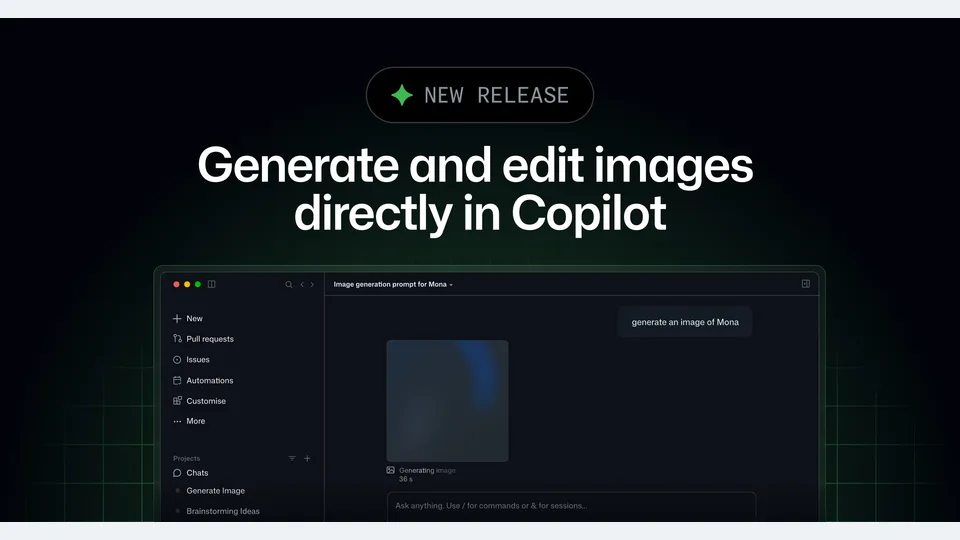
Generate and edit images directly in Copilot

You can now generate and edit images using natural language in GitHub Copilot. When you ask for an image, your selected reasoning model calls a dedicated image-generation tool powered by… The post Generate and edit images directly in Copilot appeared first on The GitHub Blog.

新闻源配图 · GitHub Copilot changelog
Timeline and related coverage

b11928

model: Add MiniCPM-OCR-Jev (#30980) * model : add MiniCPM-OCR-Jev support The model is a Qwen3.5-VL trunk with a value head read at the last token: it scores an OCR text against an image rendered from it, it does not generate. Add the openbmb-minicpm-ocr-jev decision type, served by POST /v1/systemone. The class scores are the pooled output of the sequence, read with last pooling, so the conversion turns score.weight into cls.output and sets embedding_length_out. The checkpoint has no LM head, so text generation is rejected instead of using the output weights duplicated from the token embeddings. The task is fixed, so its prompt is entirely in the systemone template, the same way h2o-lightning keeps its default there. The processor of the checkpoint allows up to 16384 merged tokens per ima

Timeline and related coverage

ProtoEEG: Structured Prototype Alignment for EEG Visual Decoding

arXiv:2610.33065v1 Announce Type: new Abstract: EEG visual decoding remains difficult because scalp recordings are noisy, spatially coarse, and variable across trials and subjects. Most systems align each trial with a dense image embedding, although that embedding mixes semantic content with instance-specific texture, pose, and background. This target can demand details absent from EEG and provides no explicit account of the visual factors supporting a prediction. We propose \textbf{ProtoEEG}, a prototype-mediated framework that reformulates EEG--image alignment as soft composition over a shared learnable visual codebook. A trainable EEG encoder and a frozen visual teacher produce assignment distributions over the same $K=64$ prototypes. Their weighted reconstructions form a structured rep

Timeline and related coverage

A Canary in the Neural Mine: Catching an Image Classifier's Silent, Confident Failures

arXiv:2610.33063v1 Announce Type: new Abstract: Deployed vision models auto-accept confident predictions, so high-confidence errors propagate silently. Maximum Softmax Probability (MSP), the standard failure predictor, has a structural blind spot: as a scalar read from the classifier head, it is first-order blind to feature variation orthogonal to its confidence gradient. Through a factorial analysis of feature-space detectors, we identify a conditional-redundancy principle explaining why they fail to complement MSP: the class-separability geometry they measure is already encoded in MSP and collapses under fusion. The signal that survives is class-conditional typicality on the off-manifold residual---and because this residual's distribution varies by backbone, from near-Gaussian to heavy-t

Timeline and related coverage

Oddin: Latent Visual Reasoning in Unified Multimodal Models via Self-Distillation from Image Generation

arXiv:2610.33062v1 Announce Type: new Abstract: Unified large multimodal models (ULMMs) are able to perform visual reasoning through interleaved text-image generation, but generating explicit intermediate images incurs significant computational overhead. While visual latent reasoning addresses this, most existing methods rely on vision-language models (VLMs) incapable of visual generation. We propose Oddin, a novel framework enabling latent visual reasoning in ULMMs. Oddin replaces intermediate images with compact latent tokens processed entirely by the understanding branch, reserving the generation branch for the final output image. We train the model via offline self-distillation with three objectives, final image generation losses, text distillation losses, and cross-entropy losses for

Timeline and related coverage

PhaseBreak: Proactive Temporal Protection against Unauthorized Image-to-Video Animation

arXiv:2610.33070v1 Announce Type: new Abstract: Image-to-Video (I2V) diffusion models can animate a single portrait or photograph, enabling shared images to be repurposed for motion synthesis without the subject's authorization. We study proactive visual protection against such use: before an image is released, its owner applies a bounded perturbation that preserves the sharing workflow but disrupts downstream motion generation. Existing spectral disruption objectives globally attenuate temporal representations and therefore provide limited control over subtle or spatially localized motion. Our key idea is that generated dynamics depend not only on temporal feature strength, but also on the order in which feature events occur. We propose PhaseBreak, a white-box spectral retiming protection

Timeline and related coverage

v0.43.0

## What's Changed * model_prefetch: syncrhonize all graph cleanups by @rattus128 in https://github.com/Comfy-Org/ComfyUI/pull/17178 * Add rope scaling support to MOSS-image by @kijai in https://github.com/Comfy-Org/ComfyUI/pull/17172 * [Partner Nodes] Renew partner-node sign-in tokens in API nodes by @dante01yoon in https://github.com/Comfy-Org/ComfyUI/pull/16943 * [Partner Nodes] feat(HeyGen): add HeyGen Voice instant clone and text-to-speech by @bigcat88 in https://github.com/Comfy-Org/ComfyUI/pull/17043 * [Partner Nodes] feat(ClarityAI): add Crystal Video Upscaler node by @bigcat88 in https://github.com/Comfy-Org/ComfyUI/pull/17192 * [Partner Nodes] feat(BFL): add 2K/4K resolutions to FLUX 3 Video nodes by @bigcat88 in https://github.com/Comfy-Org/ComfyUI/pull/17200 * Support MOSS-image

Timeline and related coverage

Kimi releases K3.1 Pro, offering more features at a lower price to challenge Opus 5.5.

Author | Yu Hang Yuan Editor | Jing Yu On the morning of October 23, Kimi officially posted a 24-second video on X and its Video Account. The scene shows a retro‑style vintage computer, with Kimi Code running on the screen and lines of Three.js code being typed into the terminal, generating a complex 3D scene. Keen-eyed netizens quickly spotted the answer in the model bar at the top left: “Model: Kimi K3.1.” Kimi’s official teaser video for K3.1 | Image source: X @Kimi_Moonshot Using an antiquated machine to run some of today’s most cutting‑edge 3D code—this stark contrast itself conveys what Moonshot AI is trying to say. A dozen hours later, just after midnight on October 24, right on Programmer’s Day, Kimi K3.1 Pro officially launched, accompanied by a Highspeed version that’s two to three times faster. The company promises that the full model weights will be released before November 4. More than three months have passed since the previous generation, K3, was unveiled. In those three months, Moonshot AI has experienced more than most companies see in an entire year. 01 “More for the same price”—what’s new in 0.1? First, let’s clarify what K3.1 Pro is. It isn’t an entirely new model. Moonshot AI explicitly states that K3.1 Pro is a post‑training variant of K3; the underlying architecture remains unchanged—still a hybrid expert architecture with 2.8 trillion total parameters and 104 billion activation parameters, still featuring a 1 million‑token context window, and still natively supporting image and video inputs. What has changed is the post‑training phase. According to the company, they’ve invested “significantly increased post‑training compute power,” conducting large‑scale joint reinforcement learning across hundreds of downstream tasks. To support this, they completely reengineered the underlying infrastructure—including the reinforcement learning framework, sandbox environment, and long‑context reasoning capabilities. In essence, the same brain has been retrained from scratch on how to perform its tasks. The results are reflected in benchmark scores. On Terminal‑Bench 4.0, which evaluates coding agents, K3.1 Pro achieved 65.7%, surpassing GPT‑6 Astra’s 58.2% and falling short of Claude Opus’s 66.4% by less than one percentage point. As for the previous generation, K3…

Timeline and related coverage

SAGE Benchmark and GAR Framework Released: Advancing Multimodal Semantic Alignment Evaluation

On October 26, 2026, arXiv published the paper arXiv:2610.31838v1, introducing Sense-Aligned Grounding Evaluation (SAGE)—a unified 10-candidate image-selection benchmark—along with the training‑agnostic Gloss-Augmented Reasoning (GAR) framework, designed for cross‑noun, verb, and entity‑centered multimodal grounding evaluation.

新闻源配图 · arXiv cs.CL

Why it matters:This study is the first to unify three types of tasks—VWSD, VerSe, and WikiDiverse—under a term-centric grounded evaluation protocol, introducing a mechanism for identifying hard negative samples and context‑exchange diagnostics. Empirical results demonstrate that the synergistic effect of definition enhancement and constraint‑guided reasoning can significantly improve the Hits@1 metric (from 65.90 to 71.22), thereby providing a more fine-grained, interpretable new evaluation paradigm for multimodal semantic alignment.

Timeline and related coverage