According to InfoQ, during her talk at the Craft Conference, Chelsea Troy pointed out that while generative AI accelerates output, it cannot replace the deep learning process. Effective skill development requires returning to the principles of cognitive science, emphasizing a slower pace, confronting discomfort, spaced repetition, outcome prediction, and diversified formats.
This report is based on an authoritative interview and transcript of her speech published by InfoQ on October 28, 2026. It focuses on the essence of software engineering education, systematically integrating cognitive science with frontline development practices, offering clear guidance and timely relevance for talent cultivation amid the current proliferation of AI tools.
On October 19, 2026, MiniMax released its low-cost large model, M3.1Flash, which scored 42 points in comprehensive evaluations and boasts a 70% reduction in cost compared to the previous generation. However, it immediately faced accusations of “cheating on exam questions”: on AA’s publicly available past papers, it nearly achieved a perfect score, yet continued to produce the original answers even after the question stems were rewritten. Reviewers such as Cat Boss and Binkg pointed out that its performance on old and new questions is sharply divided, token consumption is abnormal, and its hallucination rate in knowledge tests reaches as high as 92.8%. On October 23, MiniMax open-sourced the model weights for independent verification, but the mechanisms behind its question-identification capabilities and the reasons for discrepancies in Chinese–English responses remain unresolved.
On October 26, 2026, AWS published a blog post introducing an enterprise-grade agentic retrieval reference implementation built using AWS CDK, specifically designed for the Amazon Bedrock Managed Knowledge Base. It supports cross-knowledge-base semantic routing, iterative retrieval, cited provenance-based answers, and seven-layer observability.
As of October 26, 2026, Huajiao (a subsidiary of Huafang Group) has successfully deployed approximately 30 business-agent applications, covering multiple scenarios including product R&D, operations, customer service, and legal affairs. Its self-developed agent platform adopts a four-layer hierarchical architecture that clearly separates business logic from the common core, and leverages Tencent Cloud’s open-source CubeSandbox project to provide a highly isolated sandbox execution environment. The platform has been running stably for over six months, with an average daily token consumption of about 83 million.
On October 26, 2026, Chen Wan, the creator of the paid research briefings for the new energy industry chain, deleted the two-year‑maintained cleaner.py (web‑page cleaning script) and sites.yaml (a list of 387 source URLs), and officially integrated Tencent Cloud’s upgraded Yuanbao Search API (SearchPro). Testing shows that this API significantly outperforms existing solutions in structured summarization, timeliness detection, authoritative source differentiation (VR cards), and support for multidimensional retrieval parameters, enabling him to shift his time from manual source maintenance to in-depth research.
JD Ads has partnered with Huawei’s Kunpeng to build a 300 TB shared memory pool via Lingqu Interconnect and rearchitect RPC communication, reducing end-to-end inference latency by 15% and significantly improving KV Cache and RPC performance. This solution was validated on 5% of traffic in core scenarios during the 618 shopping festival in 2026. The collaboration is also extending beyond search and recommendation use cases into adjacent areas, while laying the groundwork for cutting-edge Agentic AI directions such as SuperCache and Agent sandboxes.
Joonko’s former CEO, Ilit Raz, pleaded guilty in October 2026 to federal securities fraud for misrepresenting to investors about the company’s customers, revenue, and AI capabilities, thereby fraudulently securing approximately $27 million in funding. He faces up to 20 years in prison. This case underscores that falsifying key business metrics can result in personal legal liability, and that directors and officers (D&O) insurance provides limited coverage in instances of established fraud.
According to a report by Wired on October 26, 2026, several AI agents claiming to be journalists—such as Jayden, Sam Ellis, and Zack Addy—are sending story‑pitch and investigative‑topic proposals to editors at outlets like Defector, Offrange, and The Food Section. However, none of these pitches have been accepted or published so far. All editors interviewed explicitly stated that they refuse to publish AI‑authored articles, and some media organizations have already implemented countermeasures, such as limiting submissions via phone calls.
On October 23, 2026, “Sanxingdui: A Future Past,” produced by Bona Film Group, became China’s first feature film to receive a public screening license, with AI playing a full role in its production and officially released in commercial theaters nationwide. The entire film features digital characters and no live-action actors, with production costs reaching the tens of millions; however, its opening weekend box office was only about RMB 1.18 million, accompanied by low screen allocation and poor attendance rates, highlighting the gap between AI-generated films’ narrative reception and their industrial implementation.
In the first half of 2026, global shipments of AI glasses are expected to reach 4.2 million units, up 127% year over year. Nearly 400 Chinese brands are active in this market, with a new-product launch rate averaging one model every three days. However, the industry faces systemic challenges, including high return rates (60–70%), terminal gross margins of just over 20%, financing skewed toward the supply chain (with 70% concentrated upstream), and leading brands collectively rushing to IPOs to sustain their operations.
A recent study published on October 26, 2026, on arXiv (arXiv:2610.31821v1) shows that, in classical Arabic poetry retrieval tasks, the degree to which users retain fragments of poetic lines—such as whether they can recall half a line—plays a more critical role in determining retrieval performance than model capabilities. BM25 outperforms all dense encoders, including state-of-the-art models with 8B parameters, on “tip-of-the-tongue” queries, but falls significantly behind on abstract queries.
Meta stated that, due to strong opposition from publishers regarding AI training terms, it may further postpone the implementation of its new commercial terms—originally scheduled for October 30, 2026, and later extended to November 20. The company emphasized that it will only proceed with policy adjustments after completing comprehensive consultations with industry organizations and leaders.
According to a report by Titanium Media on October 26, 2026, Tencent’s AI product QClaw will officially shut down on December 24, 2026, having operated for only 188 days since its public beta launch in March 2026; users will be redirected to WorkBuddy. This case exemplifies the widespread “quick launch, quick exit” pattern among eight leading Chinese AI companies—including Alibaba, Baidu, and ByteDance—across ten major AI market segments: standalone AI applications are rapidly giving way to general-purpose assistants, with the industry’s focus now shifting toward personal intelligent agents.
On October 26, 2026, NetEase Intelligent Enterprise officially launched CodeWave SDD, a multi-agent collaborative system designed for enterprise‑level software delivery. Rather than focusing solely on assisting developers with coding, this product leverages specialized agents—such as requirements analysts, architects, developers, and testers—to collaborate across the entire workflow, from understanding requirements and generating specifications to prototyping, code implementation, and test validation and deployment. Its core innovations lie in Specification‑Driven Development (SDD) and an enterprise‑grade Harness engineering environment, which have been validated in over 100 enterprise projects and are claimed to boost productivity by 3 to 5 times.
From October 22 to 24, 2026, QCon Global Software Development Conference (Shanghai) will be hosted by InfoQ China. Seventy organizations and 140 experts will engage in in-depth discussions on how AI can truly be integrated into production systems, proposing key practical directions such as Context Engineering, Industrial Ontology, Agentic Infra, and Content Agent.
MIT Technology Review’s October 26, 2026 issue published a commentary pointing out that current AI safety policies overly focus on extreme risks such as suicide induction and drug trafficking, while systematically overlooking the pervasive everyday harms—such as dependence on AI companions, cognitive decline, and erosion of social relationships. Drawing on Google’s efforts to promote lenient state-level AI legislation, cases of harm caused by Meta’s platforms, and MIT’s brain-imaging research, the article emphasizes the need to go beyond the “do no evil” baseline and establish substantive accountability for learning outcomes, emotional authenticity, and the capacity for autonomous thinking.
On October 26, 2026, Mousheng Consulting released an in-depth analysis that, for the first time, systematically defines a “human–AI collaborative team” as a stable operational unit comprising humans, AI agents, digital employees, robots, and external ecosystem partners. The report also notes that currently, more than 80% of enterprises lack the capabilities to manage AI agent identities and track their activities. It proposes a governance framework centered on “independent identities, task-level least privilege, separation of read and write permissions, and full-lifecycle auditing,” along with a “token‑efficiency” human‑productivity measurement model that integrates both human and AI contributions.
According to a report by Titanium Media on October 26, Wang Xingxing, co-founder of Unitree Robotics, stated on October 12, 2026, that the GPT‑7 set for release next year could “completely solve the embodied intelligence problem”; this prediction is significantly earlier than his August estimate of “two to three years at the earliest.” Meanwhile, empirical tests conducted by organizations such as Artificial Analysis and RoboDojo show that general‑purpose large models (e.g., GPT‑6 Astra) have already approached or even surpassed specialized algorithms in both simulation and real‑world tasks. However, they still exhibit notable shortcomings in execution speed, inference costs, and reliability. Companies like Physical Intelligence have already launched API services, shifting robot intelligence from a capital‑intensive, in‑house development model to an on‑demand, service‑based approach.
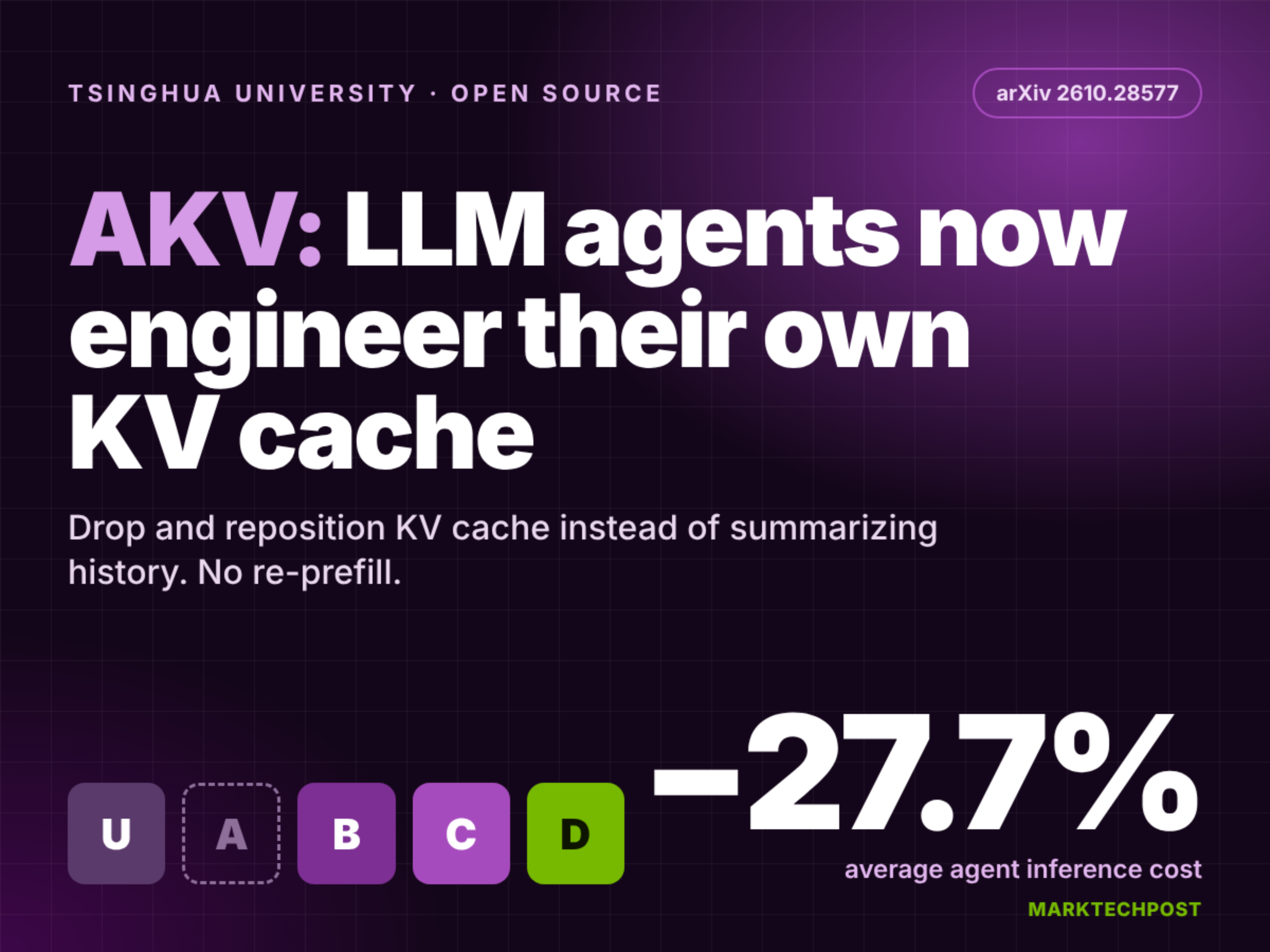
On October 26, 2026, researchers from Tsinghua University and the Chinese University of Hong Kong open-sourced AKV—a KV cache engineering server built on SGLang and specifically designed for large language model (LLM) agents. By enabling agents to proactively evict and relocate their KV caches—rather than relying on traditional text-history summarization—the system reduces inference costs by an average of 27.7% across four agent benchmarks and improves task scores by 1.7 points on average. The code is licensed under the Apache-2.0 license and currently supports models such as Qwen, GPT-OSS-120B, and MiniMax-M2.7.
An AI research paper published on October 26, 2026, on arXiv (ID 2610.31820v1) states that, for large language models (LLMs) trained using value-based reinforcement learning (value-based RL), their existing critic modules can serve as high-accuracy, highly calibrated confidence estimators without requiring additional training or data.
On October 26, 2026, arXiv published a preprint paper titled “SPECMEM: Accelerating Agentic Tool Calling via Live Memory Management” (ID 2610.31840v1), introducing a new system called SpecMem that significantly reduces tool-call latency by enabling cross-session, online, user-level memory management for tool invocations.
An arXiv paper (2610.31678v1) points out that, in interactive evaluations of large language models, relying solely on the overall accuracy or F1 score of automated scorers can mask prompt-specific errors, leading to misjudgments of prompt effects. Empirical evidence shows that the same scorer exhibits substantial variation in its false-positive rate across different prompts (2.6%–33.3%), and a seemingly significant 9.3-point effect shrinks to 2.3 points—and becomes non-significant—under dual-LLM review.
The paper “MisconceptDialogue: Evaluation Criteria Shape Measured Success in LLM Math Tutoring,” published on arXiv on October 26, 2026, introduces the MISCONCEPTDIALOGUE automated evaluation framework, which assesses the performance of five open-source small-parameter LLMs (7B–14B) as math tutoring models through over 5,000 rounds of dialogue. The study finds that the mainstream exact-match scoring method achieves only a 42.1% remediation success rate, whereas an expert‑calibrated LLM referee evaluates the same dialogues at 81.3%, a gap of 39.2 percentage points; moreover, this discrepancy is not accidental—four types of LLM referees show high agreement with 200 human‑annotated results, with a maximum kappa coefficient of 0.91. In addition, the models exhibit virtually no differentiation in their responses to diagnostic information (correct or incorrect concepts), indicating their limited ability to effectively leverage such diagnostic inputs.
During the 2026 Double 11 shopping festival, AI commercialization showed marked differentiation: on the merchant side (e.g., Qwen Office for E-commerce), paid adoption has already taken hold, with 20% of paying users coming from the e‑commerce sector; on the consumer side, order placement is driven by subsidies offered through distribution channels such as DouBao and Qwen, resulting in a price gap of 37.5%, yet user trust remains low (only 16.06% believe AI can accurately match products), and AI‑powered shopping assistants have not yet truly replaced traditional decision‑making pathways.
Zhen’an Technology (300767.SZ) announced on October 26, 2026, that it plans to acquire, in cash, no less than 51% of the equity interest in Shenzhen Sanwei Mechanical and Electrical Equipment Co., Ltd., a transaction expected to constitute a major asset restructuring. This marks the company’s second acquisition of an affiliated thermal‑control asset within the year; earlier, in March 2026, it had acquired a 51% stake in Dongchuang Jingyi. The deal aims to strengthen its upstream precision‑manufacturing capabilities in the computing‑power thermal‑control value chain. However, the company’s core business continues to shrink, it has posted consecutive losses over the past three years, maintains high leverage, and faces an accounts‑receivable bad‑debt ratio approaching 40%, with the effectiveness of its transformation still pending verification.
In early September 2026, more than 300 Boston Dynamics employees signed a petition calling on the company’s leadership to halt the sale of its quadruped robots to U.S. Immigration and Customs Enforcement (ICE). Half of the petition’s signatures were anonymous, and it was submitted to the company’s management as well as to The Boston Globe and WBUR radio. Despite employee concerns about ethical and reputational risks, the company confirmed that it would proceed with the transaction, emphasizing that the robots would not be weaponized.
Indian AI data services company iMerit launched the iMerit Scholars platform on October 26, 2026, aiming to help AI developers recruit and manage domain experts with backgrounds in fields such as medicine, agriculture, and mathematics, thereby supporting model evaluation, fine-tuning, and validation. The platform leverages its Ango Hub technology stack and integrates Trolley Technologies’ payment compliance capabilities, emphasizing experts’ proactive “challenging” of models and their ability to identify errors.
On October 26, 2026, arXiv published the paper arXiv:2610.31838v1, introducing Sense-Aligned Grounding Evaluation (SAGE)—a unified 10-candidate image-selection benchmark—along with the training‑agnostic Gloss-Augmented Reasoning (GAR) framework, designed for cross‑noun, verb, and entity‑centered multimodal grounding evaluation.
A paper published on October 26, 2026, on arXiv (ID 2610.31681v1) points out that traditional structured generation treats the mapping from input to output as a deterministic one-to-one function, which conflicts with the inherent multiplicity of semantic validity in natural language. The authors reformulate this as a “fuzzy-perception reasoning problem,” constructing a candidate structure space represented as a graph and performing graph-based reasoning to enhance output stability and robustness while preserving semantic ambiguity.
On October 26, 2026, arXiv published the paper arXiv:2610.31683v1, introducing the Schema Coherence Inventory (SCI)—a 96-item forced-choice scale designed to assess whether the beliefs attributed to persona-conditioned language models genuinely structure their cognition, rather than merely eliciting emotional responses.