Patch release v5.24.1
The v5.24.1 patch release includes fixes for vLLM backward compatibility, remote code issues, Llama4 forward crashes, dory static cache, expert parallelism with empty tp_plan, and strided checkpoint reads on PyTorch 2.9.
Search headlines, summaries and articles to connect the dots.
The v5.24.1 patch release includes fixes for vLLM backward compatibility, remote code issues, Llama4 forward crashes, dory static cache, expert parallelism with empty tp_plan, and strided checkpoint reads on PyTorch 2.9.
The author explores streaming MoE (Mixture of Experts) model experts directly from SSD to achieve near-Strata performance on a 32GB MacBook M5, using a custom implementation in Hugging Face Transformers. By optimizing expert caching, leveraging Metal kernels, and minimizing host-GPU synchronization delays, the approach reaches ~14 tok/s—within 6% of Strata's performance—demonstrating that efficient expert streaming is feasible on consumer hardware without C++ extensions.
This blog post provides scripts and Docker containers for fine-tuning TRELLIS.2, a 3D generation model, using LoRA adapters on footwear data from the Google Scanned Objects (GSO) dataset. The approach focuses on improving geometric accuracy by training only the sparse-structure and shape flow diffusion transformers while freezing the texture stage. The process includes preprocessing with Blender to generate 16 views per object, converting meshes into latents, and training with Hugging Face Jobs or local Docker. Results show significant improvements in F-score, chamfer distance, and normal consistency on held-out test objects, demonstrating effective adaptation for specific 3D object categories.
Zyphra released ZYFA, open-source FP8 and BF16 prefill attention kernels for AMD Instinct MI355X. On real model activations, its FP8 kernels run 1.16-1.76x faster than AMD’s AITER, with 62-78% lower error at head dimension 128. The post Zyphra ZYFA: FP8 FlashAttention for AMD MI355X, Up to 1.76x Faster appeared first on MarkTechPost.
arXiv:2611.07105v1 Announce Type: new Abstract: For sufficiently large transformer-based Large Language Models (LLMs), whose parameters cannot be retained in on-chip caches, prefill throughput on multi-socket CPUs is often limited by sustainable DRAM bandwidth rather than peak floating-point throughput. In the standard PyTorch compilation (i.e., TorchInductor) path, model weights are allocated without considering the Non-Uniform Memory Access (NUMA) topology: specifically, the affinity between memory banks and compute cores is disregarded. This causes a substantial fraction of weight accesses to traverse the inter-socket interconnect, severely degrading the effective memory bandwidth available to each socket. We address this bottleneck through a compiler-level solution that makes TorchInductor NUMA-aware. Treating each NUMA socket as an independent tensor-parallel partition, we introduce NUMA-aware Tensor Parallelism (NUMA-TP). This approach transparently shards weights across sockets and schedules compute kernels such that thread pools and memory allocations remain strictly local to their respective sockets using CPU affinity. We evaluate the approach on GPT-2 (117M, 345M, 762M) and BERT (Small, Large), which exercise standard multi-head attention and MLP, as well as Gemma 3 270M, which combines Multi-Query Attention with a GeGLU-gated MLP. By strictly enforcing data locality, our approach successfully mitigates cross-socket traffic, achieving prefill speedups of up to 2.63x on a dual-socket Haswell platform, up to 1.87x on a dual-socket Cascade Lake platform, and up to 2.27x on a four-socket Haswell-EX platform.
Phonon, a small text-to-speech model that runs entirely on the user's device without requiring internet access, has been released with support for English, French, German, Spanish, and Portuguese. Built on the Pocket TTS lineage using flow matching, Phonon achieves high-quality audio in compact sizes (65 MB and 75 MB), with the 31m version licensed under Apache 2.0 for commercial use. It excels in intelligibility and speed, ranking first in German and Spanish on Hugging Face's Open TTS Leaderboard and leading in CPU streaming benchmarks. The model supports voice cloning, custom voices via Gradium Studio, and integrates with Hugging Face Transformers. It is available in multiple formats and backends, including WebAssembly, GPU, and NPU, enabling deployment across phones, laptops, single-board computers, and browsers. Over 200,000 downloads were recorded in its first two weeks, with active developer adoption through tools like ExecuTorch, Micdrop, and Spaces. Future developments include support for additional languages, smaller models, and custom vocabulary fine-tuning.
Mirendil released Fern 0.1, its first model, pretrained from scratch with a 10M-token context window. It targets agentic AI R&D work, scores 100% on RULER single needle at 10M, but trails frontier models on agentic coding. The post Mirendil Launches Fern 0.1, Its First Model, With 10M-Token Context appeared first on MarkTechPost.
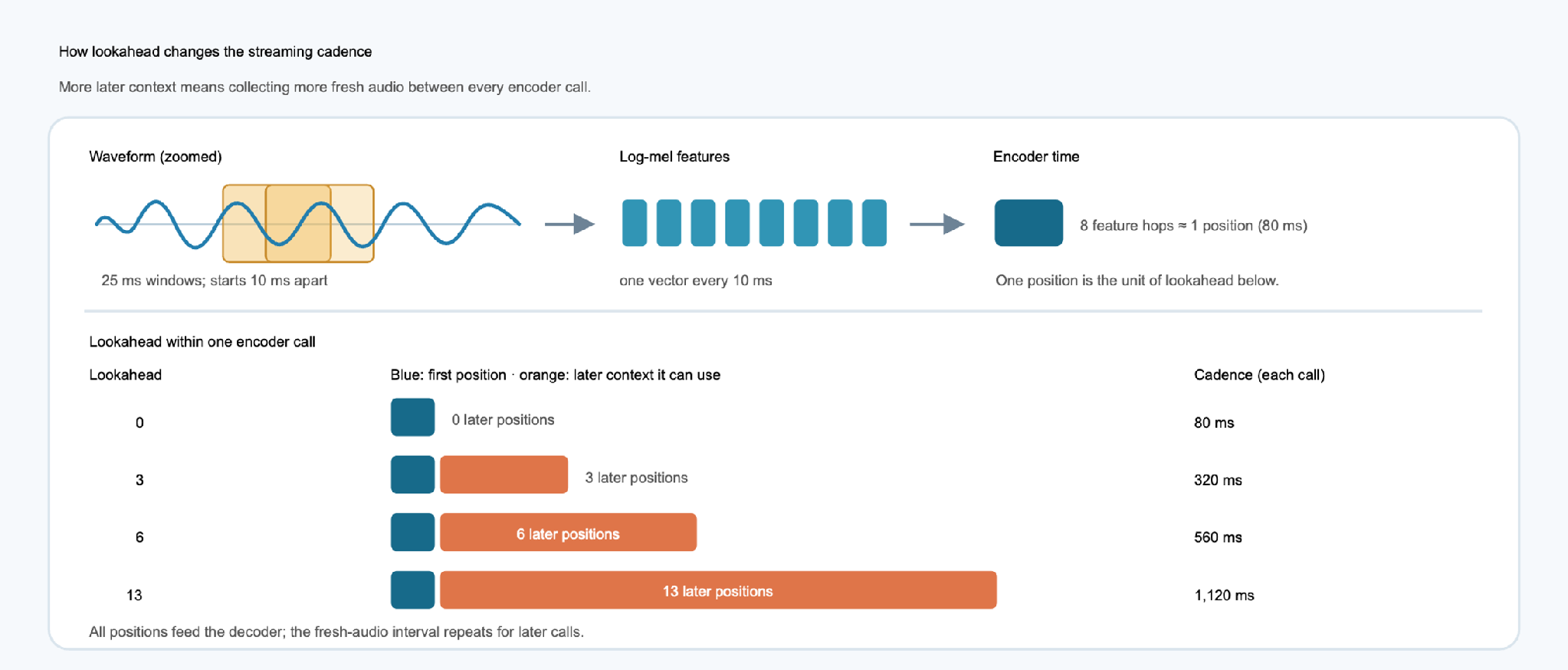
When you’re speaking to a device, you expect text to appear as you talk. That makes streaming automatic speech recognition (ASR) a different challenge from batch transcription, where the model... The post Optimizing Streaming Speech Recognition on Arm® Edge Devices with ExecuTorch appeared first on PyTorch.