

What is Salad Transcription API?
This tool corresponds to SaladCloud’s transcription API, not its full suite of GPU cloud products. Its core function is to convert audio into machine-readable text, while providing speaker diarization, word-level timestamps, and subtitle output—making it easy to integrate into podcasting, interview recording, meeting minutes, and content‑processing workflows.
The official website distinguishes between the Transcription API and Transcription Lite. The former is geared toward tasks that prioritize batch transcription accuracy, offering capabilities such as audio enhancement, custom vocabularies, summarization, sentiment analysis, classification, and custom prompts; Lite, on the other hand, emphasizes turnaround speed and core transcription functionality. Pricing and support scopes for each must be reviewed separately—do not directly apply one’s features or pricing to the other.
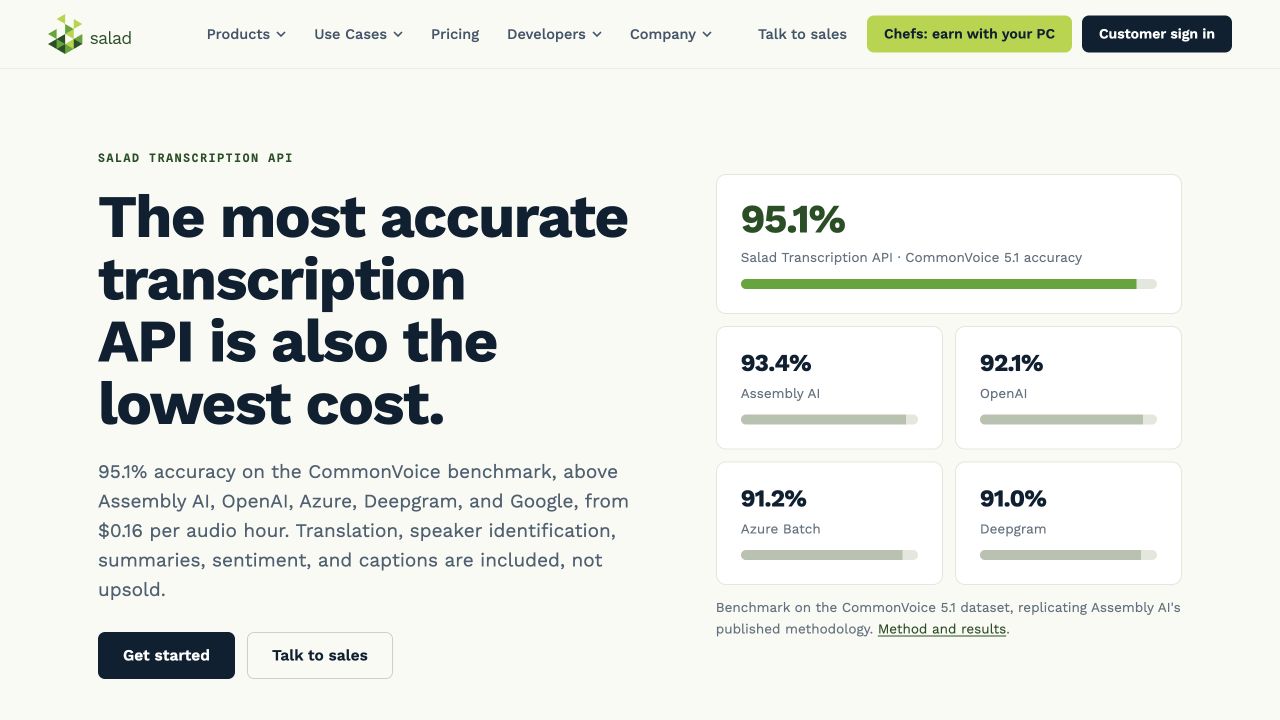
The accuracy figures shown on the official website are based on the CommonVoice benchmark it has annotated, and represent results obtained under specific datasets and methodologies. They do not reflect the actual performance across all languages, accents, recording devices, or noise conditions. Before deployment, you should validate the transcriptions, speaker labels, and timestamps using your own audio, paying particular attention to domain-specific terminology and overlapping speech.
Fees are calculated based on audio duration and monthly usage tiers; according to the official website, no charges apply for failed transcriptions. When scaling up to large-scale integration, in addition to the per‑minute rate, you should also evaluate processing time, task status, and downstream subtitle or text workflows. Special deployments and higher usage volumes will require separate assessment under the official enterprise plan.
Key features
Transcription: speech recognition, speaker diarization, and word-level timestamping.
Subtitles: Supports output formats such as SRT, serving audiovisual content workflows.
Analysis: The Standard Edition lists capabilities related to summarization, sentiment analysis, classification, and custom vocabularies.
Solution Selection: The Standard API and Lite are tailored to different accuracy and turnaround requirements.
Use cases and audience
Teams that need to transcribe content in bulk, media platforms, and voice app developers.
The audio to be transcribed and the corresponding API task settings.
Transcribed text, speaker labels, timestamp information, subtitles, or text analysis results.
How to use
- 01
Access the developer documentation from the official website to distinguish the applicable scopes of the Standard API and the Lite version.
- 02
Prepare audio files with the necessary permissions and submit the task according to the API requirements.
- 03
Read the task status and output, and verify the text, speaker, and subtitle timestamps.
- 04
Choose a plan based on your sample performance and monthly audio volume.
Benefits and limitations
Benefits
- Transcription, time-stamping, and subtitles can all be obtained in a single API workflow.
- It offers both the Standard and Lite editions, making it easy to compare based on task requirements.
Limitations
- The official benchmark accuracy does not equal your own recording accuracy; sample validation is required.
- The feature set, processing speed, and monthly usage unit price vary across different versions.
Pricing and availability
Paid
Monthly 0–8,333 audio hours.
Monthly 8,334–16,666 audio hours.
Monthly 16,667–33,333 audio hours.
Monthly 0–8,333 audio hours; see the official website for other usage tiers.
The currency is USD, with billing based on audio duration; the minimum billing increment is 0.01 hour (36 seconds). According to the official website, there is no charge for failed transcriptions; for usage exceeding 33,333 hours per month, please contact sales.
- Pricing source
- https://salad.com/transcription/
- Pricing last updated
- 2026-10-22
Prices and limits may change. Check the official website for current terms.
Official website & sources
Sources
Updated on 2026-10-21