
Searching for distant planets with Astra
See how two amateur astronomers used Codex and Astra to find potential exoplanets in public data from NASA’s Kepler and TESS space telescopes.
Search headlines, summaries and articles to connect the dots.
See how two amateur astronomers used Codex and Astra to find potential exoplanets in public data from NASA’s Kepler and TESS space telescopes.
Learn how OpenAI built the Performance Factory, a system of Codex-powered workflows that finds and fixes performance issues to help keep ChatGPT fast.
Agents interact with software through a funnel similar to humans: Discovery, Selection, Access, and Success. To measure whether agents complete user tasks correctly, end-to-end (E2E) evaluations are essential. These tests run multiple trials, score outcomes, and help identify failures across steps like searching cafes, checking budgets, and placing orders. Using frameworks like Harbor, teams can define tasks with specific instructions, environments, verifiers, and known-good solutions. Metrics such as success rate, Pass@k, and Pass^k reveal how reliably agents perform, while trace analysis uncovers root causes of failure. The process includes setting a goal based on observability, customer feedback, or roadmap needs; defining measurable metrics; designing task sets covering common and edge cases; running evaluations at scale using tools like Vercel Sandbox and AI Gateway; and analyzing traces to iterate improvements. Automated trace analysis enables scaling, and repeated evaluation supports continuous improvement, regression detection, and product optimization.
Agents interact with software through a funnel similar to humans: Discovery, Selection, Access, and Success. To measure whether agents complete user tasks correctly, end-to-end (E2E) evaluations are essential. These evaluations assess the full sequence of steps an agent takes, ensuring outcomes meet user requirements. Using frameworks like Harbor, developers can design tasks with defined environments, verifiers, and known-good solutions, then run trials across variants to measure success rate, pass@k, pass^k, efficiency, time, and cost. Analyzing traces reveals root causes of failures, enabling targeted improvements. Iterative evaluation helps catch regressions, test changes, and guide product development, turning evaluations into ongoing infrastructure for building better agent-driven products.
Article URL: https://www.wired.com/story/meet-the-sad-wives-of-ai/ Comments URL: https://news.ycombinator.com/item?id=50438429 Points: 27 # Comments: 13
What does old me think
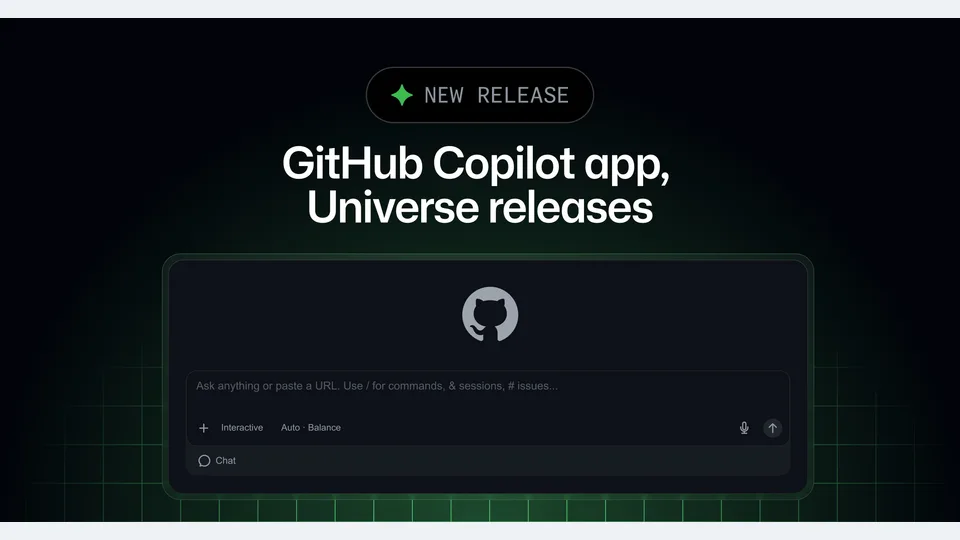
Work doesn’t always fit in a single repository or session. A feature can span several repositories. A launch plan can pull in specs, designs, and assets without touching a repository… The post GitHub Copilot app, Universe releases appeared first on The GitHub Blog.
How to set up and run an offline coding agent using OpenCode, Ollama and Qwen.
GPT-6.1 Terra, OpenAI’s newest model, is now generally available in GitHub Copilot. It is designed for everyday agentic coding and terminal work at a lower cost than GPT-6.1 Sol. In… The post GPT-6.1 Terra in GitHub Copilot appeared first on The GitHub Blog.