Skip to content
AI NEWS JOURNAL
AI, IN PERSPECTIVE

All AI updates

Explore the complete news stream by source, topic and date.

Newest first

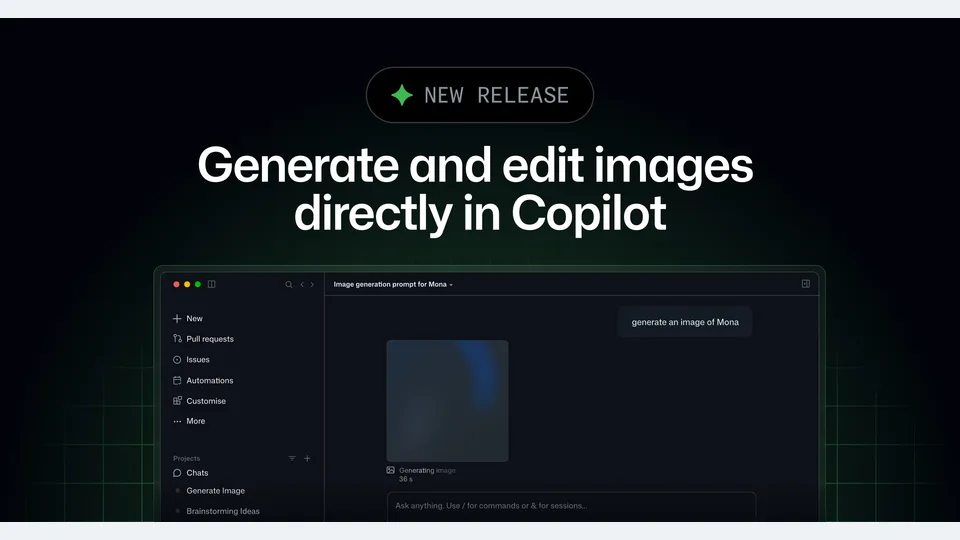
Generate and edit images directly in Copilot

You can now generate and edit images using natural language in GitHub Copilot. When you ask for an image, your selected reasoning model calls a dedicated image-generation tool powered by… The post Generate and edit images directly in Copilot appeared first on The GitHub Blog.

新闻源配图 · GitHub Copilot changelog
Timeline and related coverage

AI programming capabilities are reshaping hiring standards, with Anthropic’s head of recruiting scrapping traditional coding interviews.

Felix Rieseberg, Anthropic’s recruitment manager and engineering lead for Claude-related products, stated that his team has eliminated traditional coding‑question interviews, bluntly declaring, “Coding interviews are dead—at least for my team.” He argues that AI tools like Claude can effortlessly tackle small React challenges and even low‑level assembly tasks, diminishing the value of conventional coding tests in distinguishing candidates’ true engineering abilities. As a result, interview outcomes may increasingly reflect the performance of AI tools rather than the candidate’s actual skill level.

AI编程能力改变招聘标准,Anthropic招聘负责人取消传统编程面试
Timeline and related coverage

GitHub Copilot supports server-to-server authentication

GitHub Copilot now supports server-to-server authentication for GitHub Apps installed on organizations, available in public preview. Services and agents built with the GitHub Copilot SDK can now make requests on… The post GitHub Copilot supports server-to-server authentication appeared first on The GitHub Blog.

新闻源配图 · GitHub Copilot changelog
Timeline and related coverage

Manus has just quietly unveiled its 2.0 manifesto.

On October 26, Zhang Tao (online alias HideCloud), co-founder and product partner at Manus, recently published a lengthy article on his WeChat official account “Qianyun Sisi,” titled “Transforming Manus with Manus.” The piece opens with an image that left a deep impression on him. He had submitted several requirements and bug reports to an engineer; when he checked back a while later, he found that the engineer’s computer had multiple Codex and Manus sessions running side by side. Clicking on any one of them, he typed in what he had just been working on...

Manus,刚刚悄悄发布了自己的2.0宣言
Timeline and related coverage

GPT-6.1 Terra in GitHub Copilot

GPT-6.1 Terra, OpenAI’s newest model, is now generally available in GitHub Copilot. It is designed for everyday agentic coding and terminal work at a lower cost than GPT-6.1 Sol. In… The post GPT-6.1 Terra in GitHub Copilot appeared first on The GitHub Blog.

Timeline and related coverage

Microsoft offers buyouts to 60,000 employees

Microsoft is offering voluntary buyouts to up to 60,000 employees across the US, UK, Canada, and India. In a message to employees, Microsoft chief people officer Amy Coleman writes that this gives staff members "the opportunity to leave Microsoft with financial support and career planning resources" as the company looks to trim staff without another […]

Microsoft offers buyouts to 60,000 employees
Timeline and related coverage

TACS-RF: Tool-driven Agentic Circuit Synthesis of RF and mmWave Modules

arXiv:2610.31882v1 Announce Type: new Abstract: We present the framework of TACS-RF - a Tool-driven Agentic Circuit Synthesis of RF and mmWave modules. In this framework, a large-language-model (LLM) coding agent (Claude Opus 4.8) directly drives industry-standard electronic-design-automation (EDA) tools such as Cadence Virtuoso/Spectre, Calibre, Cadence EMX, and Ansys HFSS to design RF and mmWave modules. We validate the framework through the agentic design of a 240-251 GHz sub-THz transmitter in a 90 nm SiGe BiCMOS process. The agent semi-autonomously designed the sub-blocks including a 60 GHz push-push Colpitts VCO with second-harmonic extraction, multistage differential cascode power drivers, a push-push frequency doubler, a differential bowtie antenna, and all the interstage matching

TACS-RF: Tool-driven Agentic Circuit Synthesis of RF and mmWave Modules
Timeline and related coverage

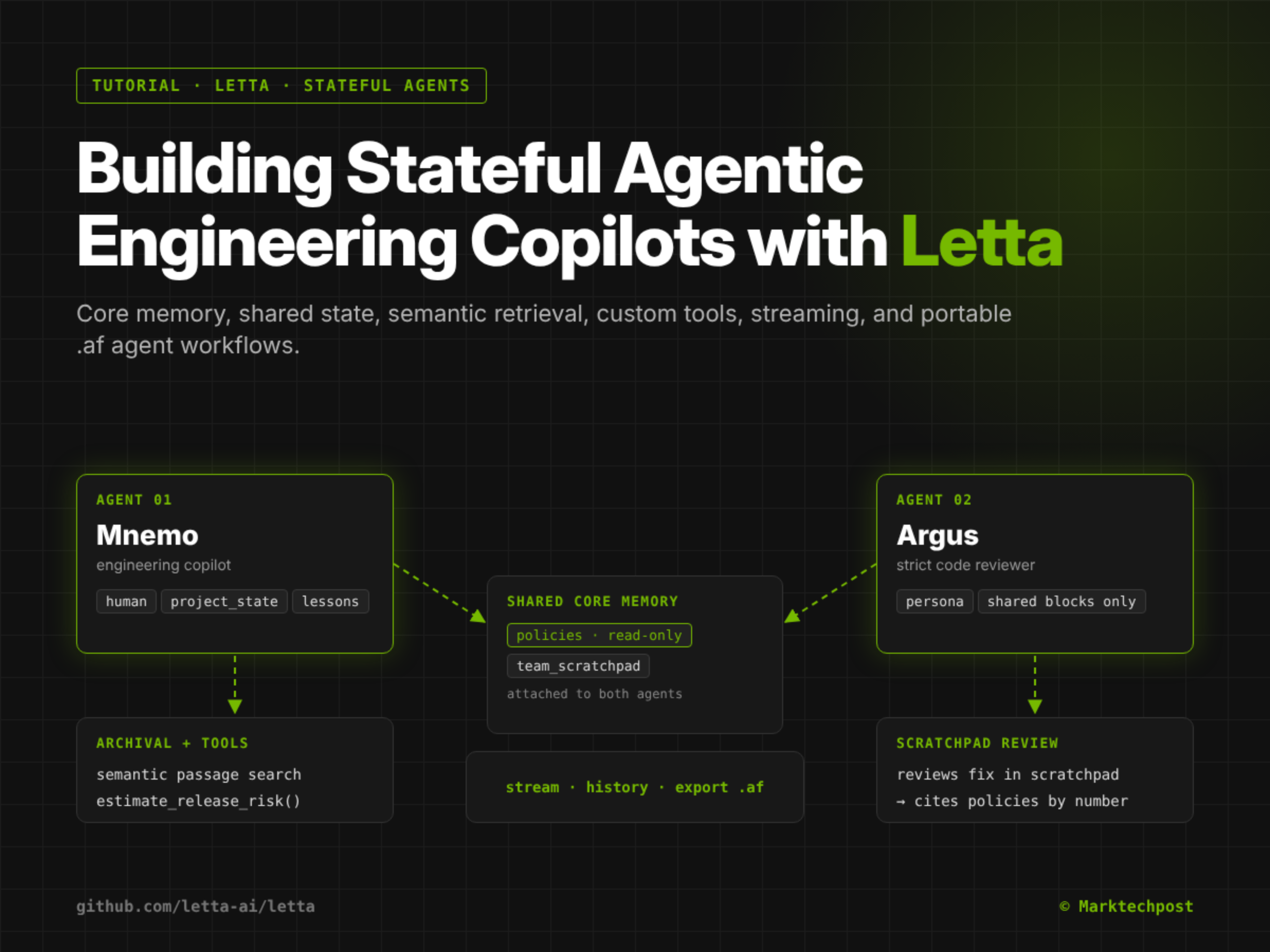
Letta platform releases a tutorial on building stateful engineering collaborators: supporting core memory, shared state, and portable workflows.

MarkTechPost published a tutorial on October 24, 2026, detailing how to build an agentic copilot with persistent state using the Letta framework. The guide covers capabilities such as verifiable core memory, multi-agent shared memory, semantic retrieval of archived knowledge, custom Python tool integration, streaming responses, and .agent format (.af) export. The content serves as a technical practice guide and does not provide performance metrics, security audits, or production‑environment validation.

Stateful Agentic Engineering Copilots with Letta: Core Memory, Shared State, Semantic Retrieval, Custom Tools, Streaming, and Portable Agent Workflows
Timeline and related coverage

How Three Java Champions Leverage GitHub Copilot to Boost Development Efficiency: Focusing on Human-AI Collaboration and Shared Responsibility

Vlad Mihalcea, Patrick Baumgartner, and Frank Delporte, three seasoned Java Champions, shared their experiences using GitHub Copilot in production environments and open-source projects, emphasizing human-led problem definition, context anchoring, iterative validation, and ultimate accountability—rather than relying on AI to automatically generate code.

Timeline and related coverage

How to seamlessly resume a GitHub Copilot session in VS Code

GitHub’s official tutorial explains how to import an entire Copilot session—complete with generated code changes, conversation context, and the working tree—into Visual Studio Code with a single click, enabling an end-to-end collaboration workflow that requires no branch rebase, preserves all context, and allows you to review/edit/test directly before pushing to the associated pull request.

Timeline and related coverage

Quoting Addy Osmani, Morgan Westlee Lunt, and Qing Wang

We think "did a human read the code?" is an imprecise proxy for "what could go wrong with this change, and which check—automated or human—is the right one to catch it?" Asking that question also changed when review happens. Before, review was a gate at the end of the road: write the code, open a PR, wait for your colleague. Now, review runs continuously, more like spellcheck while you write. Most changes have been reviewed and fixed by Claude at least once before a human is asked to look. This catches most routine mistakes, and saves team attention for higher-level questions and scrutiny. — Addy Osmani, Morgan Westlee Lunt, and Qing Wang, How the Claude Code team does code review Tags: anthropic, claude, ai, claude-code, llms, addy-osmani, coding-agents, generative-ai, agentic-engineering,

Timeline and related coverage

sparqlite: SPARQL 1.1 inside SQLite, written in Rust

Research: sparqlite: SPARQL 1.1 inside SQLite, written in Rust This research task is really an experiment in running Claude Code for web in "Ultracode" mode, as described in Orchestrate subagents at scale with dynamic workflows in the Claude Code documentation. With Ultracode turned on, Claude Code makes aggressive use of dynamic workflows - it generates JavaScript that defines and coordinates a network of subagents to take on complex problems. My initial prompt was this - I meant "hit the rows directly", the word "delete" was an accidental typo on my phone: Write a SQLite extension in Rust that implants SPARQL and runs really fast because it can hit the delete rows directly This caused Claude Code for web to churn for over 12 hours. I checked in on its progress the next day and sent a sin

Timeline and related coverage